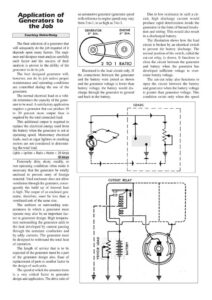
Application of enerators to the Job an automotive generator (generator speed with reference to engine speed) may vary from 2-to-1, to as high as 3-to-1. Courtesy Delco-Remy The final selection of a generator that will adequately do the job required of it depends upon many factors. The engi- neer and designer must analyze carefully each factor and the success of their analysis is proven in the ability of the generator to do its job. The best designed generator will, however, not do its job unless proper maintenance and operating conditions are controlled during the use of the generator. The normal electrical load on a vehi- cle determines the capacity of the gener- ator to be used. A satisfactory application requires a generator that can produce 10 to 20 percent more output than is required by the total connected load. This additional output is required to replace the electrical energy used from the battery when the generator is not at operating speed. Momentary electrical loads, such as cigar lighters or cranking motors are not considered in determin- ing the total load. Lights + Ignition + Radio + Heater = 29 Amps 35 Amps Extremely dirty, dusty, muddy, or wet operating conditions often make it necessary that the generator be totally enclosed to prevent entry of foreign material. Total enclosure does not allow ventilation through the generator, conse- quently the build up of internal heat is high. The output of an enclosed gen- erator, therefore, must be less than a ventilated unit of the same size. The ambient or surrounding tem- peratures in which a generator must operate may also be an important fac- tor in generator design. High tempera- ture surrounding the generator adds to the heat developed by current passing through the armature conductors and by eddy currents. The generator must be designed to withstand the total heat of operation. The length of service that is to be expected of the generator must be a part of the generator design also. Ease of replacement of parts is another factor in the design of such units. The speed at which the armature turns is a very critical factor in generator design and application. The drive ratio of ENGINE 6” DIA. GENERATOR 3” DIA. 2 TO 1 RATIO Illustrated is the load circuit only. If the connections between the generator and the battery were joined as shown and the generator voltage is lower than battery voltage, the battery would dis- charge through the generator to ground Due to low resistance in such a cir- cuit, high discharge current would produce rapid deterioration inside the generator in the form of burned insula- tion and wiring. This would also result in a discharged battery. The illustration shows how the load circuit is broken by an electrical switch to prevent the battery discharge. The normal position of the switch, called the cut-out relay, is shown. It functions to close the circuit between the generator and battery when the generator has developed sufficient voltage to over- come battery voltage. The cut-out relay also functions to open the circuit between the battery and generator when the battery voltage is greater than generator voltage. This and back to the battery. condition exists only when the speed LOADS CT 7 | | | | | | | | | | ) | i 1 oF Fy I | I i -} a 7 —–—-t—-—— a ) | Le _ 1 1 VEHICLE LOAD BATTERY Se See ee ee a eee oo rtd