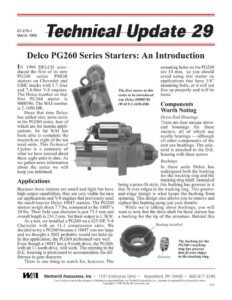
87-278-1 March 1996 Delco PG260 Series Starters: An Introduction IN 1994 DELCO intro- duced the first of its new PG260 series PMGR starters on Chevrolet and GMC trucks with 5.7-liter and 7.4-liter V-8 engines. The Delco number on that first PG260_ starter is 9000786. The WAI number is 2-1690-DR. Since that time Delco has added nine more units to the PG260 series, four of which are for marine appli- cations. So far WAI has been able to complete the research on eight of the ten total units. This Technical Update is a summary of what we have learned about these eight units to date. As we gather more information about the series we will keep you informed. Applications Because these starters are small and light but have high output capabilities, they are very viable for race car applications and V-8 engines that previously used the much heavier Delco 10MT starters. The PG260 starters weigh about 7.7 Ibs, compared to the 1|OMT’s 20 lbs. Their field case diameter is just 73.5 mm and overall length is 234.2 mm. Yet their output is 1.7K W. As a test, we installed a PG260 on a 425-HP, V-8 Chevrolet with an 11.1 compression ratio. We decided to try a PG260 because a 1OMT was too large and we thought a 5MT probably would not hold up. In this application, the PG260 performed very well Even though a 1OMT has a 9-tooth drive, the PG260, with an 11-tooth drive, will work. The opening in the D.E. housing is positioned to accommodate the dif- ference in gear diameter. There is one thing to watch for, however. The Wil Wetherill Associates, Inc.- 1101 Enterprise Drive – mounting holes on the PG260 are 10 mm, so you should avoid using this starter on applications that have 3/8” mounting bolts, or it will not The first starter in this line up properly and will be series to be introduced loose. was Delco #9000786 (WAI # 2-1690-DR) Components Worth Noting Drive-End Housings There are four unique drive- end housings for these starters, all of which use needle bearings — although all other components of the unit use bushings. The sole- noid is attached to the D.E. housing with three screws Bushings In these units Delco has redesigned both the bushing for the tracking ring and the tracking ring itself. Instead of being a press-fit style, this bushing has grooves in it that fit over ridges in the tracking ring. This groove- and-ridge design is what keeps the bushing from spinning. This design also allows you to remove and replace this bushing using just your thumbs. While we’re talking about bushings, you will want to note that the drive shaft for these starters has a bushing for the tip of the armature. Behind this Bushing installed The bushing for the PG260’s tracking ring has grooves that fit over ridges in the tracking ring. Grooves Royersford, PA 19468 + 800-877-3340 Care is taken to ensure the accuracy of information presented here, but Wetherill Associates, Inc., assumes no responsibility for possible errors. Copyright © 1996 Wetherill Associates, Inc. 4754 Technical Update 29 page 2 bushing is a small metal stop-disk that keeps the armature from going in too far. This stop-disk will not come out until the bushing is removed. Then it will just fall out. Also note that there are bushings in all three planetary gears for this starter, as well as in the C.E. cap. In order to remove the bushing in the C.E. cap, you must first remove the dust cover on the outside of the bushing. C.E. Cap This brings us to the C.E. cap. There are four dif- ferent C.E. caps for these starters, all of which look very similar. You can differentiate among these caps by looking at two features: the loca- tion of the thru-bolt mounting holes in relation to the motor lead and whether or not the cap has a hole for a drain tube. The location of the thru-bolt mounting holes and whether or not it has a hole for a drain tube are the only differences in the C.E. caps for these starters. Field-Case Assembly The PG260 series has two different field-case assemblies, each with four Magnequench® mag- nets mounted in a zinc-chromate frame. The only difference between these two assemblies is that the position of the tabs that locate the field case to the D.E. housing are different in relation Tabs locate the field case to the D.E. housing to the tabs for the C.E. cap. These tabs also keep you from installing the field case facing the wrong direction, which would change the direc- tion of the starter. Also note that there is a gasket between the field case and the D.E. housing. Drives These starters have two different starter drives: a 9-tooth and an 11-tooth. A 9-tooth drive (WAI # 54-156) is used on Delco starter #9000805 for Cadillac and Oldsmobile with Northstar engines. The more popular 1 1-tooth drive (WAI # 54-155) fits all the other starters we researched. Brush Holder The brush holder is also new for this starter. Negative brushes are spot-welded to the brush-holder plate. Pos- itive brushes are spot- welded to a bus bar. The brush holder uses tor- sion springs to prolong brush life. The brush holder is new for these starters. Solenoid Two different solenoids are used in these units. One has four terminals and is used in starters #9000821 and #9000822 for marine applica- tions. The other solenoid has three terminals and is used in automotive applications and other marine applications. The battery and motor ter- minals are both M8; the S and R terminals are MS. Although the solenoid is sealed with an inte- gral cover, it is still able to be serviced. You may be aware that on permanent-magnet starters there has been an inherent problem with the contact disk welding to the motor and battery terminals. In the PG260 series Delco has taken steps toward solving this problem by using a movable contact disk that is attached to the sole- noid plunger. So now the large solenoid plunger- return spring also helps break this contact. For more information about PG260 Series PMGR Starters, see WAI catalog 87-255-96