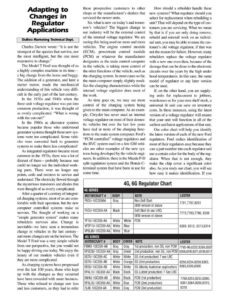
Adapting to Changes in Regulator Applications DuBois Marketing Technical Dept. Charles Darwin wrote: “It is not the strongest of the species that survive, nor the most intelligent, but the one most responsive to change.” The Model T Ford was thought of as a highly complex machine in its time— a big change from the horse and buggy. The addition of a generator, and later a starter motor, made the mechanical understanding of this vehicle very diffi- cult in the early part of the last century. In the 1930s and 1940s when the three-unit voltage regulator was put into common production, it was thought of as overly complicated. “What is wrong with the cut-out?” In the 1960s as alternator systems became popular those who understood generator systems thought these new sys- tems were too complicated. Some vehi- cles were converted back to generator systems to make them less complicated! As integrated regulators became more common in the 1970s, there was a lot of distrust of them— probably because one could no longer see the individual work- ing parts. There were no longer any points, coils and resistors to service and understand. The electricity flowed through the mysterious transistors and diodes that were thought of as overly complicated. After a quarter of a century of integrat- ed charging systems, most of us are com- fortable with their operation, but the new computer controlled systems make us nervous. The thought of working on a “simple generator system” makes many rebuilders nervous also. Change is inevitable-we have seen a tremendous change in vehicles in the last century— and more changes are on the horizon. The Model T Ford was a very simple vehicle from our perspective, but you would not be happy driving one today. We enjoy the luxury of our modern vehicles even if they are more complicated. As charging systems have progressed over the last 100 years, those who kept up with the changes as they occurred have been rewarded with more business. Those who refused to change saw less and less customers, as they had to refer these prospective customers to other shops or the manufacturer’s dealers that serviced the newer units. So, what is new on today’s and tomor- row’s vehicles? The biggest change to our industry will be the external control of the internal voltage regulator. We are seeing this being used on more and more vehicles. The engine control module (ECM), powertrain control module (PCM) or whatever the manufacturer designates as the main control computer in the vehicle, is taking more control of the other functions of the vehicle, such as the charging system. In most cases so far, the main computer simply slightly modi- fies the charging characteristics while the internal voltage regulator does most of the work. As time goes on, we may see more control of the charging system being given to the main computer. As an exam- ple, Chrysler has never used an internal voltage regulator on most of their domes- tic vehicles but over the last few years have tied in more of the charging func- tions to the main system computer. Ford’s “PCM controlled” voltage regulators and the RVC system used on a few GM vehi- cles are other examples of the new sys- tems being developed by the vehicle engi- neers. In addition, there is the Mazda P-D split regulation system and the Honda C- terminal system that have been in use for some time. How should a rebuilder handle these new systems? What regulator should you select for replacement when rebuilding a unit? That will depend on the type of cus- tomers you are servicing. What we mean by that is if you are only doing remove, rebuild and reinstall work on an individ- ual unit, you may be able to reuse the cus- tomer’s old voltage regulator, if that was not the reason for failure. However, many rebuilders replace the voltage regulator with a new one even then, because of the damage that can be done to the electronic circuits over the years by the high under hood temperatures. In this case, the same model of regulator or any later version can be used. If, on the other hand, you are supply- ing units for replacement to jobbers, warehouses or for your own shelf stock, a universal fit unit can save on inventory costs. In these instances, using the latest version of a voltage regulator will ensure that your unit will function in all of the earliest and latest applications of that unit. Our color chart will help you identify the latest version of each of the new Ford regulators. Ford makes identification of most of their regulators easy because they cast a part number into each regulator and use a certain color for the body of the reg- ulator. When that is not enough, they make the chip cover a significant color also. As you study our chart, you will see how easy it makes identification. If you F50U-100359-AA | Black YF1U-100359-AA VP3F1U-100359-AA White White 4G, 6G Regulator Chart |_| NOTE LESTER 4G SERIES MOTORCRAFT # _| BODY F6DU-10C359AA | Gray | [Non Soft Start [oe version oFabove |