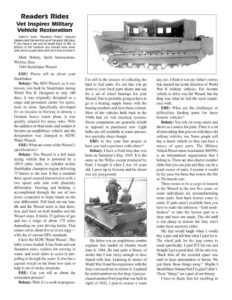
Reader’s Rides Vet Inspires Military Vehicle Restoration Editor’s Note: “Reader’s Rides” features classic cars that remind us of the good old days. If you have a car you’ve loved back to life, or photos of the treasure you should have never sold, send us your story and we’d love to share it. Mark Bohaty, Spirit Aerosystems, Wichita, Kan. 1944 Studebaker Weasel ERE: Please tell us about your Studebaker. Bohaty: The M29 Weasel, as it was known, was built by Studebaker during World War II. Designed in only 180 days, it was originally designed as a cargo and personnel carrier for opera- tions in snow. Specifically developed for an invasion in Norway to destroy a German heavy water plant, it was quickly adapted for many roles. With the addition of float tanks and rudders it became an amphibious vehicle and the designation was changed to M29C Water Weasel. ERE: What are some of the Weasel’s specifications? Bohaty: The Weasel is a full track laying vehicle that is powered by a 169.9 cubic inch, six cylinder in-line Studebaker champion engine delivering 75 horses to the rear. It has a standard three speed manual transmission with a two speed axle unit with planetary differential. Steering and braking is accomplished through the use of two levers connected to brake bands on the rear differential. Pull back on one han- dle and the Weasel turns in that direc- tion, pull back on both handles and the Weasel stops. It holds 35 gallons of gas and has a range of about 175 miles depending on your driving habits. That comes out to about five to seven mpg — a bit shy of current EPA standards. I have the M29C Water Weasel. This baby comes loaded. It has front and rear floatation tanks, rudders for steering in water, and track skirts to assist in pro- pelling it through the water. It also has a capstan winch on the front bow tank to help it out of sticky situations. ERE: Can you tell us about the restoration process? Bohaty: Well, it’s a work in progress. I’m still in the process of collecting the hard to find parts. It’s not like you go down to your local parts dealer and ask for a set of wheel bearings for your Weasel. You’re probably going to have to go to a bearing supply house with the bearing numbers and have them ordered. Most of the vehicles built back in the 1940s had six volt electrical systems. Those components are generally rebuilt as opposed to purchased new. Light bulbs are still available at some automo- tive specialty shops though. ERE: Is this your first project or have you had experience with others? Bohaty: I have a Ford Jeep that was born on Valentine’s Day, 1945. It is the same as the Willys except produced by Ford. I bought it when I was 18 years old. I grew up in Arizona and the desert was my playground. My father was an amphibious combat engineer that landed on Omaha beach June 6, 1944. He had quite a library of stories that I was lucky enough to have shared with him. Listening to stories of World War II and his experience with the Jeep convinced me to restore it. I painted his serial numbers on that Jeep. I just pur- chased another Ford jeep that was built in April of 1942. I plan to restore it some day, too. I think it was my father’s stories that steered me in the direction of World War II military vehicles. His favorite vehicle to drive was the Weasel, but the Jeep was what he had the most experi- ence with. ERE: What are the challenges or difficulties finding parts for these historic vehicles? Bohaty: You rely on swap meets and shows as a source for parts. There is a lot of networking that goes on with these old military vehicles, too. Some people will buy a donor vehicle so they can have a source of spare parts. The Military Vehicle Preservation Association (MVPA) is an international organization that I belong to. There are also charter member clubs that you can join and they can be a good source of parts. I assume it would be the same for those that restore the 60s or 70s muscle cars. There seems to be a surge of interest in the Weasel in the last five years, so some individuals are remanufacturing some parts. Seat back frames come to mind. If parts aren’t available then you have to make the infamous “field modi- fication” or take the broken part to a shop and have one made. The old stuff is not cheap to restore but they don’t make them anymore either. My dad would laugh when I would buy a part and tell him what I paid for it. The wheel jack for the jeep comes to mind specifically. I paid $75 for one and thought I got a good deal. All he said was, “Back then all the essential space was used to keep ammunition or booze. We just threw those things away!” Maybe I should have listened but I’m glad I didn’t. Those “things” are a part of our history. I have to thank him for instilling in