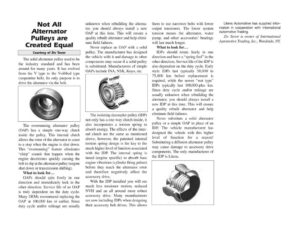
Not All Alternator Pulleys are Created Equal Courtesy of Ziv Tavor The solid alternator pulley used to be the industry standard and has been around for many years. It has evolved from the V type to the V-ribbed type (serpentine belt). Its only purpose is to drive the alternator via the belt. – The overrunning alternator pulley (OAP) has a simple one-way clutch inside the pulley. This internal clutch allows the rotor of the alternator to coast to a stop when the engine is shut down. This “overrunning” feature eliminates “chirp” sounds that happen when the engine decelerates quickly causing the belt to slip at the alternator pulley (engine shut down or transmission shifting). What to look for… OAPs should spin freely in one direction and immediately lock in the other direction. Service life of an OAP is truly dependent on the duty cycle. Many OEMs recommend replacing the OAP at 100,000 km or earlier. Since duty cycle and/or mileage are usually unknown when rebuilding the alterna- tor, you should always install a new OAP at this time. This will ensure a quality rebuilt alternator and help elimi- nate field failures. Never replace an OAP with a solid pulley. The manufacturer has designed the vehicle with it and damage to other components may occur if a solid pulley is substituted. Manufacturers of simple OAPs include INA, NSK, Koyo, etc. The isolating decoupler pulley DP) not only has a one-way clutch inside, it also incorporates a torsion spring to absorb energy. The effects of the inter- nal clutch are the same as mentioned above, however, the patented internal torsion spring design is the key to the much higher level of function associated with the IDP. The internal spring is tuned (engine specific) to absorb base engine vibrations (cylinder firing pulses) before they reach the alternator rotor and therefore negatively affect the accessory drive. With the IDP installed you will see much less tensioner motion, reduced NVH and an all around more robust accessory drive. Many manufacturers are now including IDPs when designing their accessory belt drives. This allows them to use narrower belts with lower output tensioners. The lower system tension means the alternator, water pump, and other accessories’ bearings will last much longer. What to look for… IDPs should rotate freely in one direction and have a “spring feel” in the other direction. Service life of the IDP is also dependent on the duty cycle. Early style IDPs last typically 50,000 to 75,000 km before replacement is required, while the newer “wet type” IDPs typically last 100,000-plus km. Since duty cycle and/or mileage are usually unknown when rebuilding the alternator, you should always install a new IDP at this time. This will ensure a quality rebuilt alternator and help eliminate field failures. Never substitute a solid alternator pulley or a simple OAP in place of an IDP. The vehicle manufacturer has designed the vehicle with this higher level of function for a_ reason! Substituting a different alternator pulley may cause damage to accessory drive components. The only manufacturer of the IDP is Litens. Litens Automotive has supplied infor- mation in cooperation with International Automotive Trading. Ziv Tavor is owner of International Automotive Trading, Inc., Woodside, NY.