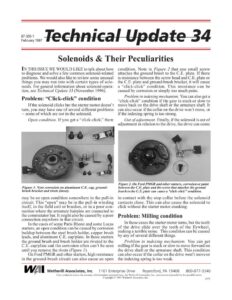
87-359-1 February 1997 Solenoids & Their Peculiarities IN THIS ISSUE WE WOULD LIKE to talk about how to diagnose and solve a few common solenoid-related problems. We would also like to review some unusual things you may run into with certain types of sole- noids. For general information about solenoid opera- tion, see Technical Update 33 (November 1996). Problem: “Click-click” condition If the solenoid clicks but the starter motor doesn’t turn, you may have one of several different problems — some of which are not in the solenoid. Open condition. If you get a “click-click,” there Figure 1. Note corrosion on aluminum C.E. cap, ground- brush bracket and rivets (inset). may be an open condition somewhere in the pull-in circuit. This “open” may be in the pull-in winding itself, in the field coil or brushes, or in a poor con- nection where the armature hairpins are connected to the commutator bar. It might also be caused by a poor connection anywhere in that circuit. In the cases of some Paris Rhone and some Lucas starters, an open condition can be caused by corrosion buildup between the steel brush holder, copper brush leads, and aluminum C.E. cap/plate. In these starters the ground brush and brush holder are riveted to the C.E. cap/plate and the corrosion often can’t be seen until you remove the rivets (Figure /). On Ford PMGR and other starters, high resistance in the ground-brush circuit can also cause an open y /4 || Wetherill Associates, Inc. 1101 Enterprise Drive condition. Note in Figure 2 that one small screw attaches the ground brush to the C.E. plate. If there is resistance between the screw head and C.E. plate or the C.E. plate and ground-brush bracket, it will cause a “click-click” condition. This resistance can be caused by corrosion or simply too much paint. Problem in indexing mechanism. You can also get a “click-click” condition if the gear is stuck or slow to move back on the drive shaft or the armature shaft. It can also occur if the collar on the drive won’t move, or if the indexing spring is too strong. Out of adjustment. Finally, if the solenoid is out of adjustment in relation to the drive, the drive can come Figure 2. On Ford PMGR and other starters, corrosion or paint between the C.E. plate and the screw that attaches the ground brush to the C.E. plate can cause a “click-click” condition. in contact with the stop collar before the solenoid contacts close. This can also cause the solenoid to click without the starter motor cranking. Problem: Milling condition In these cases the starter motor turns, but the teeth of the drive slide over the teeth of the flywheel, making a terrible noise. This condition can be caused by any of several different things. Problem in indexing mechanism. You can get milling if the gear is stuck or slow to move forward on the drive shaft or the armature shaft. This condition can also occur if the collar on the drive won’t move or the indexing spring is too weak. Royersford, PA 19468 800-877-3340 Care is taken to ensure the accuracy of information presented here, but Wetherill Associates, Inc., assumes no responsibility for possible errors. Copyright © 1997 Wetherill Associates, Inc. 5379 Technical Update 34 page 2 Out of adjustment. If the solenoid is out of adjustment in relation to the starter drive so the solenoid contacts close before the drive is engaged with the flywheel, you will also get a milling condition. Problem: Nothing happens One of the reasons for this problem is “heat soaking” of the solenoid. A solenoid is said to be heat soaked if it is so overheated that the resis- tance of the windings does not allow enough cur- rent flow for the solenoid to operate. However, a couple of other things can also cause the sole- noid to be completely dead. High voltage drop. There may be too much voltage drop to the S-terminal. This can come from high resistance in the vehicle wiring or high resistance across one or more switches (ignition switch, neutral safety switch, clutch safety switch, etc.). Plunger too far out. In other cases the plunger may have moved so far out of the bore that it is extremely hard to pull it back in. This can happen if something is bent or out of adjustment. Problem: Solenoid kicks in and out rapidly (machine-gun noise) Poor ground. Most of the time the hold-in winding in the solenoid is spot-welded to a steel plate. If this wire is broken or the plate does not make a good ground to the case of the solenoid, the solenoid will be operating only on the pull- in winding. Because the pull-in winding loses its magnetism as soon as the contacts close between the battery terminal and motor ter- minal, the plunger returns to its stationary posi- tion and the contacts open. But because the ignition switch is still in the cranking position, current starts to flow again in the pull-in winding, which pulls the plunger in, closing the contacts again, and the whole procedure starts over. This causes a “machine-gun” noise as the solenoid kicks in and out. Cap turned. If the solenoid cap is turned 180° so the terminals are opposite to where they should be, you can also get a machine-gun noise. In this case the windings that are normally ter- minated at the switch terminal are now con- nected to the motor terminal, and vice versa. Bad battery. A bad or poorly charged bat- tery can also cause a solenoid to kick in and out. Under these conditions the solenoid current flow lowers the already low battery voltage even further, which means the solenoid cannot stay engaged. But when the solenoid releases and the battery voltage goes back up, the sole- noid engages and we start all over again. This also will cause a machine-gun noise as the sole- noid kicks in and out. Peculiarities of certain solenoids Bosch For Chrysler. In the three groups of Bosch starters for Chrysler shown in the chart below, different OE units interchange as complete units but have slightly different solenoids. (Some other parts differ as well.) For example, in the chart you will note that there are four OE numbers under 2-1385-BO. Two of them use solenoid 66-9132 and one uses a 66-9182. The fourth starter (0-001-108-046), however, had two versions; Rev | used the 66- 9132 and Rev 2 used the 66-9182. According to the bill of materials, the solenoid is the only Solenoids for Bosch Starters for Chrysler 2-1380-BO 0-001-108-013 PMGR 66-9132 0-001-208-407 DD 66-9182 0-001-208-413 DD 66-9132 2-1385-BO 0-001-108-032 PMGR 66-9132 0-001-108-045 PMGR 66-9132 0-001-108-046 PMGR — 66-9132/66-9182 0-001-108-068 PMGR 66-9182 2-1387-BO 0-001-108-066 PMGR — 66-9132/66-9182 0-001-108-069 PMGR — 66-9182 0-001-108-104 PMGR 66-9164 0-001-108-134 PMGR 66-9164 0-331-303-020, 22 66-9132 0-331-303-108 66-9182 0-331-303-086,137 66-9164 2-339-303-208 66-9164 66-9132, 66-9182 S-terminal M4 x 0.7 Post 66-9164 S-terminal M5 x 0.8 Post