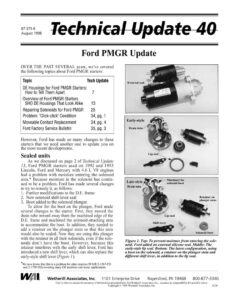
87-375-6 August 1998 Ford PMGR Update OVER THE PAST SEVERAL years, we’ve covered the following topics about Ford PMGR starters: DE Housings for Ford PMGR Starters: How to Tell Them Apart Overview of Ford PMGR Starters SHO DE Housings That Look Alike 13 Repairing Solenoids for Ford PMGR = 25 Problem: “Click-click” Condition 34, pg. 1 Moveable Contact Replacement 34, pg. 4 Ford Factory Service Bulletin 35, pg. 3 Topic Tech Update However, Ford has made so many changes to these starters that we need another one to update you on the most recent developments. Sealed units As we discussed on page 2 of Technical Update 13, Ford PMGR starters used on 1992 and 1993 Lincoln, Ford and Mercury with 4.6 L V8 engines had a problem with moisture entering the solenoid area.* Because moisture in the solenoid has contin- ued to be a problem, Ford has made several changes to try to remedy it, as follows: 1. Further modifications to the D.E. frame 2. New solenoid shift-lever seal 3. Boot added to the solenoid plunger. To allow for the boot on the plunger, Ford made several changes to the starter. First, they moved the drain tube inward away from the machined edge of the D.E. frame and machined the solenoid-attaching area to accommodate the boot. In addition, they needed to add a retainer on the plunger stem so that this area would also be sealed. Now they are using this plunger with the retainer in all their solenoids, even if the sole- noids don’t have the boot. However, because this retainer interferes with the early shift lever, Ford has introduced a new shift lever, which can also replace the early-style shift lever (Figure /). *We now know that this is a problem for other starters (WAIR 2-1567-FD and 2-1799-FD) covering many OE numbers and many applications. ce External seal Early-style Drain tube Lip seal yd easy <— Machined for solenoid boot Late-style Drain tube Retainer on plunger stem Lip seal Shift lever Solenoid boot Figure 1. Top: To prevent moisture from entering the sole- noid, Ford added an external silicone seal. Middle: The early-style lip seal. Bottom: The latest configuration, using a boot on the solenoid, a retainer on the plunger stem and different shift lever, in addition to the lip seal. y fai | Wetherill Associates, Inc. 1101 Enterprise Drive Royersford, PA 19468 800-877-3340 Care is taken to ensure the accuracy of information presented here, but Wetherill Associates, Inc., assumes no responsibility for possible errors. Copyright © 1998 Wetherill Associates, Inc. 6236 Technical Update 40 page 2 . Spade M6 x 1.0 S-terminal Early Late S-terminal on left on right Figure 2. Left: Early solenoid with spade S-terminal and early brush holder. Right: Later solenoid with M6 x 1.0 S-terminal and late-style brush holder. Note change in position of flag on brush holder leads. Solenoid and brush holder Ford PMGR starters initially used a solenoid with a spade-type S-terminal. This spade terminal was on the left side of the solenoid, with the motor terminal at the bottom. This configuration allowed the motor lead on the brush holder to bolt onto the solenoid’s motor terminal without interfering with the S-terminal (Figure 2). Then in 1995 Ford introduced a number of starters that use a solenoid with an M6 x 1.0 S-termi- nal located on the right side. This design is used on applications that have the vehicle wiring coming in on that side. However, because of the position of this S-terminal, Ford also had to put a different flag on the brush holder’s motor lead, so the lead could bolt on without interfering with the S-terminal. In Figure 2, note where the flag is attached to the motor lead. This brush holder, using the late-design motor-lead configuration, can replace the early-style brush hold- er, as well. Solution to spade-terminal corrosion Sometime after they introduced the solenoid with the M6 x 1.0 S-terminal on the right, Ford began using another solenoid with an M6 x 1.0 S-terminal — this time on the left. By then they had realized that the spade-type S-terminal was having a problem with corrosion, and since then, all the starters we have purchased from Motorcraft use a solenoid with an M6 x 1.0 S-terminal, instead of a spade terminal. Figure 3. Ford con- version kit is on the left. WAL kit is on the right. Because of this tendency for the spade-type S-termi- nal to corrode, Ford developed a terminal-conversion kit that they provide with retrofit units. This kit allows the installer to convert the wiring of the vehi- cle from a spade-type to an eyelet-type S-terminal. The part number for the kit is WT-5673-B or F6VY- 14A411-AA (Figure 3). WAI also offers a conversion kit (79-2503), which gives the installer two options: They can con- vert the wiring on these units to the stud-type termi- nal or bolt on an angle male-spade terminal to the M6 x1.0 S-terminal, and use the original female spade connector. However, in our opinion, if the installer continues to use the spade connector, rebuilders will see a higher rate of returns (Figure 3). Be careful of drives that look alike The most popular drive for Ford PMGR starters has 10 teeth, a white plastic ring and a gear OD of 28mm (54-212). But be careful! The 1995-1997 Contours and Mystiques with a 4-cylinder, 2 L engine also use a 10-tooth drive (54-216) -- but the gear OD on this drive is only 27mm and the plastic ring is pink. If the wrong drive is installed, this one- millimeter difference will cause the starter to either be very noisy or to not crank at all (Figure 4). Figure 4. 10-tooth drive on the left, with white plastic ring, is not interchangeable with 10-tooth drive on the right, with pink plastic ring. You may already know that starter drives for Ford PMGR were originally produced by Mitsubishi. However, Ford then took the operation in-house and now produces all these drives themselves. Listed below are the drives produced by Ford to date. These drives look slightly different from the Mitsubishi drives, but are functionally identical to the drives they replace. Ford No. F5DU-11350-AA F5CU-11350-A F5RU-11350-AA F5VU-11350-AA WAI No. Teeth Ring color 54-212 10 White 54-214 9 Black 54-216 10 Pink 54-215 12 Green Changes in armature and planetary-drive shaft Ford made a running change in the armature shaft used in PMGR starters. The tip of the armature has been shortened by 2mm and the depth of the bore