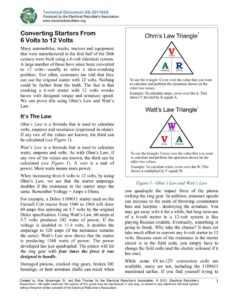
Technical Document SS-201104A > OD) www.electricalrebuilders.org Produced by the Electrical Rebuilder’s Association Converting Starters From 6 Volts to 12 Volts Many automobiles, trucks, tractors and equipment that were manufactured in the first half of the 20th century were built using a 6-volt electrical system. A large number of those have since been converted to 12 volts—usually to solve a slow-cranking problem. Too often, customers are told that they can use the original starter with 12 volts. Nothing could be further from the truth. The fact is that cranking a 6-volt starter with 12 volts wreaks havoc with designed torque and armature speed. We can prove this using Ohm’s Law and Watt’s Law. It’s The Law Ohm’s Law is a formula that is used to calculate volts, amperes and resistance (expressed in ohms). If any two of the values are known, the third can be calculated (see Figure 1). Watt’s Law is a formula that is used to calculate watts, amperes and volts. As with Ohm’s Law, if any two of the values are known, the third can be calculated (see Figure 1). A watt is a unit of power. More watts means more power. When increasing from 6 volts to 12 volts, by using Ohm’s Law, we see that the starter amperage doubles if the resistance in the starter stays the same. Remember Voltage = Amps x Ohms. For example, a Delco 1109611 starter used on the Farmall Cub tractor from 1940 to 1964 will draw 60 amps free spinning on 5.7 volts by the original Delco specification. Using Watt’s Law, 60 amps at 5.7 volts produces 342 watts of power. If the voltage is doubled to 11.4 volts, it doubles the amperage to 120 amps (if the resistance remains the same). Watt’s Law now shows that the starter is producing 1368 watts of power. The power developed has just quadrupled. The pinion will hit the ring gear with four times the force it was designed to handle. Damaged pinions, cracked ring gears, broken DE housings, or bent armature shafts can result when Ohm’s Law Triangle’ A (Amperes) To use the triangle: Cover over the value that you want to calculate and perform the operation shown on the other two values. Example: To calculate amps, cover over the A. This shows V divided by R equals A. Watt’s Law Triangle’ (Amperes) To use the triangle: Cover over the value that you want to calculate and perform the operation shown on the other two values. Example: To calculate watts, cover over the W. This shows A multiplied by V equals W. Figure I—Ohm’s Law and Watt’s Law you quadruple the impact force of the pinion striking the ring gear. In addition, armature speeds can increase to the point of throwing commutator bars and hairpins – destroying the armature. You may get away with it for a while, but long term use of a 6-volt starter in a 12-volt system is like playing Russian roulette. Eventually, something is going to break. Why take the chance? It does not take much effort to convert any 6-volt starter to 12 volts. Because most of the resistance in the starter circuit is in the field coils, you simply have to change the field coils (and the electric solenoid if it has one). While some 6V-to-12V conversion coils are available, many are not, including the 1109611 mentioned earlier. If you find yourself trying to Created by Wes Grueninger Sr. and Bob Thomas for the Electrical Rebuilder’s Association. © 2011, Electrical Rebuilder’s 1 Association—All rights reserved. No portion of this guide may be reproduced in any way, or stored in any electronic retrieval system without the prior written consent of the Electrical Rebuilder’s Association. Technical Document SS-201104A Produced by the Electrical Rebuilder’s Association www.electricalrebuilders.org & convert a starter for which no conversion coils are available, it does not mean you cannot do the conversion. It all depends on how the original 6-volt coils are configured. Typically, most 6-volt starters used either a _ two-coil parallel configuration (see Figure 2) or a four-coil series- parallel configuration (see Figure 3). With a little patience, you can convert these coils yourself using tools and parts you already have in your shop. This is assuming that the original field coils are serviceable. By The Numbers Using Ohm’s Law you can calculate the resistance in the Farmall Cub starter as it is being run in a free spin test. 5.7 Volts = 60 Amps X .095 Ohms We’ll explain later why the resistance in any starter decreases as the speed at which the Note: Current must flow through each coil in the same direction as before the conversion. Bt Balance Strap Balance Strap CONVERTED FOR ORIGINAL 6 VOLT Two 6-Volt Field Coils Connected in Parallel (Negative ground shown in examples) Two 6-Volt Field Coils Connected in Series armature spins increases. And we’ll explain why most of the .095 ohms of resistance that was calculated from the free spin test is actually in the field coils. For simplicity’s sake, we’ll say that all of the resistance is in the field coils. While this will slightly exaggerate the calculations it does not affect the outcome. Remember, the original field coils in this starter are connected in parallel. e When field coils are connected in parallel, the total circuit resistance is less than the lowest individual coil’s resistance. This is why the total resistance calculated above is .095 ohms, even when each individual coil is.190 ohms (see Footnote 2 _ for calculations) When field coils are connected in series, the total circuit resistance is the sum of each coil’s resistance added together. This is the original 6-Volt configuration. Both field coils connect to the B+ Brush Terminal Former Brush Terminal B+ 1 2 VOLT Terminal The field coils after conversion. What used to be the B+ of the right coil is jumpered to the what used to be the brush terminal on the left coil. Figure 2—Converting Two 6-Volt Parallel Coils Created by Wes Grueninger Sr. and Bob Thomas for the Electrical Rebuilder’s Association. © 2011, Electrical Rebuilder’s Association—All rights reserved. No portion of this guide may be reproduced in any way, or stored in any electronic retrieval system without the prior written consent of the Electrical Rebuilder’s Association. 2