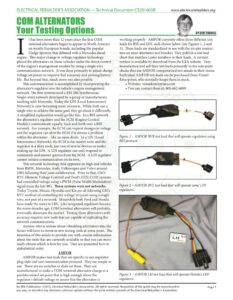
ELECTRICAL REBUILDER’S ASSOCIATION — Technical Document CS201605B www.electricalrebuilders.org COM ALTERNATORS Your Testing Options t has been more than 12 years since the first COM terminal alternators began to appear in North America on mostly European brands, including the popular Dodge Sprinter that debuted with a Mercedes diesel engine . This major change in voltage regulator technology placed the alternators on those vehicles under the direct control of the engine’s management module by using a single wire communication network. It was done primarily to adjust charge voltage set points to improve fuel economy and prolong battery life. But beyond that, much more was also possible. This communication is accomplished by incorporating the alternator’s regulator into the vehicle’s engine management network. The first systems used a BSS (Bit Synchronous Single-wire) network developed by a group of manufacturers working with Motorola. Today the LIN (Local Interconnect Network) is now becoming more common. While both use a single wire to achieve the same goal, they go about it differently. A simplified explanation would go like this. In a BSS network the alternator’s regulator and the ECM (Engine Control Module) communicate equally, back and forth over a BSS network. For example, the ECM can request changes in voltage and the regulator can alert the ECM if it detects a problem within the alternator — like an open diode. In a LIN (Local Interconnect Network), the ECM is the master node and the regulator is a slave node, just one of several devices or nodes making up the LIN. A LIN regulator can only respond to commands and answer queries from the ECM. A LIN regulator cannot initiate communication on its own. This network technology first appeared on high end vehicles from BMW, Mercedes, Audi, Volkswagon and Volvo around 2002 following their joint collaboration. Prior to that, GM’s RVC (Remote Voltage Control) and Ford’s GEN-COM systems had controlled voltage using a PWM (Pulse Width Modulation) signal since the late 90’s. Those systems were not networks. Today Toyota, Nissan, Hyundai and Kia are all following GM’s RVC method of controlling the voltage set point using a single wire, not part of a network. Meanwhile both Ford and Honda have made the move to LIN. Like integrated regulators became the norm decades ago, COM terminal alternators will probably, eventually dominate the market. Testing these alternators with accuracy requires new tools that are capable of replicating the network communication. Anyone who is serious about rebuilding alternators into the future will have to invest in new testing tools at some point. The intention of this article to provide you with concise information about the tools that are currently available so that you can more easily choose which is best for you. They are presented here in alphabetical order. AMFOR AMFOR makes test leads that are specific to one regulator plug style and one communication protocol. They are simple to use. There are no switches or dials on them. They are manufactured to make a COM terminal alternator charge at a predetermined set point that is high enough above the regulator’s default voltage to insure that the alternator is ope, BY BOB THOMAS working properly. AMFOR currently offers three different test leads for BSS and LIN, each shown below (see Figures 1, 2 and 3). These leads are standardized to use with the six-pin connec- tors on most alternator test benches. They publish a test lead chart that matches Lester numbers to their leads. A current version is available by download from the ERA website. They manufacture and sell their test leads primarily to the auto parts chains that use AMFOR computerized test stands in their stores. Individual AMFOR test leads can be purchased from Vensel Enterprises, who normally keeps them in stock. ¢ Website: venselenterprises.com e You can contact them at: 800-662-6099 Figure 1 – AMFOR BVB test lead that will operate regulators using BSS protocol. Figure 2 – AMFOR BVL test lead that will operate some LIN regulators. Figure 3 – AMFOR LH test lead that will operate Honda’s LIN regulators. An ERA Publication. ©2015, Electrical Rebuilder’s Association. All rights reserved. No portion of the guide may be reproduced in Page 1 any way, or stored in any electronic retrieval system without the prior written consent of the Electrical Rebuilder’s Association. ELECTRICAL REBUILDER’S ASSOCIATION — Technical Document CS201605B www.electricalrebuilders.org COM ALTERNATORS JIMCO JIMCO offers a single solution test apparatus to cover all current BSS and LIN alternators, including those from Honda and Ford. They introduced this second generation box at the recent ERA show in Memphis. It comes with three different regulator plugs, each identified by its plug code (see Figure 4). As you can see in the photo, it has two switches. One to choose protocol between BSS or LIN. The other allows you to change the tested regulator’s set point among three different voltages. The COM2 uses the six-pin connector that is common to most alternator test benches including those made by JIMCO. It is also capable of driving your test bench’s charge lamp if a problem is detected by the regulator. JIMCO publishes a test lead chart, with the most recent version available by download from the ERA website. It identifies which units can be tested with their COM2 and what setting to use for each one. | j » Website: jimcotest.com Figure 5 – REGITAR COM 2 test box that will operate all current – You can contact JIMCO at: 800-821-7137 BSS and LIN regulators that includes Honda and Ford. MOBILETRON FEGTAT ia” | All three of these test options can be used to test BSS or LIN alternators on a vehicle, on your test bench or in conjunction with an electronic voltage regulator tester to evaluate a regulator independently. All three products are backed up by technical help from reliable businesses located in the US. Be aware that none of these testers are made to operate the GM’s RVC, Toyota’s RLO, Ford’s GEN-COM or Nissan’s, Hyundai’s and Kia’s similar systems. Each of those requires its own test lead or a multi-switch signal generator. Do not get them confused with networked BSS or LIN alternators. Note – There are other test options that are available. D&V in ; Canada makes test leads and adapters specifically for their test eruntdiiamn benches. Other companies outside of North America market DEF nm p testers on the Internet. If you are comfortable buying test equip- . ment that way and are willing to spend more money, then you may want to check them out. Two of the more innovative ones are being made and sold by Autodiagger in Poland – autodiagger.com. Figure 4 – JIMCO COM2 test box that will operate all current BSS Special thanks goes out 2 Alan Melton of AMFOR, Scott . and LIN regulators, including those made by Ford and Honda. Scharrer of JIMCO, Gene Kaiser of Regitar and Mohammad Samii of Sammy’s Auto Electric Service for their assistance in producing REGITAR this article. Regitar offers a single solution tester, their COM 2 which was introduced at the ERA’s Memphis show (see Figure 5). This tester covers all LIN and BSS alternators manufactured by Bosch, Denso, Mitsubishi and Valeo for the North American market. That includes Honda and Ford, as well as Mercedes, Audi, BMW, Volvo and Volkswagon. As you can see in the photo, it has an off-on switch and three rotary switches. It allows testing at four different voltage settings including default with no signal. It has four error lamps, each providing specific fault information. This tester will operate with most test benches using the alligator clips provided. That includes driving a charge lamp if your test bench has one. Instructions for using Regitar’s COM 2 may be found on their website at the address below by selecting “COM Tester” from the menu. You will also find a setting guide there that can be printed. ¢ Website: regitar.com/tech-articles e You can contact Regitar at: 877-734-4827 An ERA Publication. ©2015, Electrical Rebuilder’s Association. All rights reserved. No portion of the guide may be reproduced in Page 2 any way, or stored in any electronic retrieval system without the prior written consent of the Electrical Rebuilder’s Association.