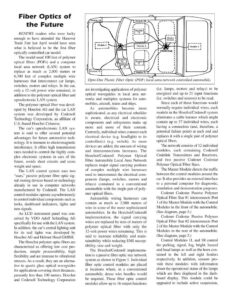
Fiber Optics of the Future RENEWS readers who were lucky enough to have attended the Hanover Trade Fair last April would have seen what is believed to be the first fiber optically controlled car model. The model used 100 feet of polymer optical fibers (POFs) and a computer local area network (LAN) system to replace as much as 2,000 meters or 6,700 feet of complex multiple wire harnesses that interconnect car lamps, switches, motors and relays. In the car, only a 12-volt power wire remained, in addition to the polymer optical fiber and optoelectronic LAN system. The polymer optical fiber was devel- oped by Hoechst AG and the car LAN system was developed by Codenoll Technology Corporation, an affiliate of U.S.-based Hoechst Celanese. The car’s optoelectronic LAN sys- tem is said to offer several potential advantages for future automotive tech- nology. It is immune to electromagnetic interference. It offers high transmission rates needed to control the highly com- plex electronic systems in cars of the future, avoids short circuits and saves weight and space. The LAN control system uses two “stars,” passive polymer fiber optic sig- nal routing devices based on technology already in use in computer networks manufactured by Codenoll. The LAN control modules operate asynchronously to control individual components such as locks, dashboard indicators, lights and turn signals. An LCD instrument panel was con- ceived by VDO Adolf Schindling AG specifically for use with the LAN system. In addition, the car’s central lighting unit for its real lights was developed by Hoechst AG and Helmut Hund GMBH. The Hoechst polymer optic fibers are characterized as offering low cost pro- duction, simple processibility, high flexibility and are immune to vibrational stresses. As a result, they are an alterna- tive to quartz glass optical waveguides for applications covering short distances, presently less than 100 meters. Hoechst and Codenoll Technology Corporation Coat tweoweent ‘ ‘ ‘ ‘s. € Module 31″ Opto-One Plastic Fiber Optic (POF) local area network controlled automobile. are investigating applications of polymer optical waveguides in local area net- works and multiplex systems for auto- mobiles, aircraft, trains and ships. As automobiles become more sophisticated, as any electrical rebuilder is aware, electrical and electronic components and subsystems make up more and more of their content. Currently, individual wires connect each electrical device (e.g. headlight) to its controller(s) (e.g. switch). As more devices are added, the amount of wiring and interconnections increases. The Hoechst/Codenoll Polymer Optical Fiber Automobile Local Area Network replaces major signal carrying portions of complex multiple wire harnesses used to interconnect the electrical com- ponents (lamps, switches, motors and relays) contained in a conventional automobile with the single pair of poly- mer optical fibers. Automobile wiring harnesses can contain as much as 2,000 meters of wire in some of the more sophisticated automobiles. In the Hoechst/Codenoll implementation, the signal carrying wires are replaced by tens of meters of polymer optical fiber with only the 12-volt power wires remaining. This is said to increase reliability and main- tainability while reducing EMI suscep- tibility, size and weight. The Hoechst/Codenoll implementa- tion is a passive fiber optic star network system as shown in Figure 1. Individual fiber optic control modules are placed at locations where, in a conventional automobile, dense wire bundles would be required. These fiber optic control modules allow up to 16 output functions (i.e. lamps, motors and relays) to be energized and up to 21 input functions (i.e. switches and sensors) to be read. Since each of these functions would normally require individual wires, each module in the Hoechst/Codenoll system eliminates a cable harness which might contain up to 37 individual wires, each having a connection (and, therefore, a potential failure point) at each end and replaces it with a single pair of polymer optical fibers. The network consists of 12 individual modules, each containing Codenoll Codelink Transmitters and Receivers, and two passive Codenet Codestar Polymer Optical Fiber Stars. The Master Module directs the traffic between the control modules around the car. It also provides an external interface to a personal computer for diagnostic, simulation and demonstration purposes. Codenet Codestar Passive Polymer Optical Fiber Star #1 interconnects Port 1 of the Master Module with the Control Modules in the front of the automobile. (See diagram, page 5.) Codenet Codestar Passive Polymer Optical Fiber Star #2 interconnects Port 2 of the Master Module with the Control Modules in the rear of the automobile. (See diagram, page 5.) Control Modules 1L and IR control the parking, signal, fog, bright, hazard and head lamps as well as the horn con- tained in the left and right fenders respectively. In addition, sensors pro