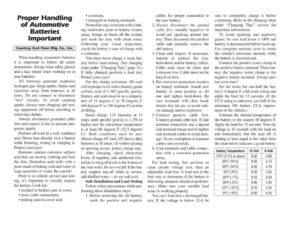
Proper Handling of Automotive Batteries Important Courtesy East Penn Mfg. Co., Inc. When handling automotive batteries it is important to follow all safety instructions. Always wear safety glasses and a face shield when working on or near batteries. All batteries generate explosive hydrogen gas. Keep sparks, flames and cigarettes away from batteries at all times. Do not connect or disconnect “live” circuits. To avoid creating sparks, always turn charging and test- ing equipment off before attaching or removing clamps. Always disconnect grounded cable first and connect it last to prevent dan- gerous sparks. Perform all work in a well ventilated area. Never lean directly over a battery while boosting, testing or charging it. Protect your eyes! Batteries contain corrosive sulfuric acid that can destroy clothing and burn the skin. Neutralize acid spills with a paste made of baking soda and water or large quantities of water. Be careful! Prior to in-vehicle service and test- ing, it’s important to visually inspect the battery. Look for: ¢ cracked or broken case or cover, ¢ loose cable connections, ¢ leaking case-to-cover seal, * corrosion, ¢ damaged or leaking terminals. Neutralize any corrosion with a bak- ing soda/water paste or battery cleaner spray. Scrape or brush off the residue and wash the area with clean water. Following your visual inspection, check the battery’s state of charge with a voltmeter. You must boost charge a weak bat- tery before load testing. (See charging chart under “Charging Tips,” page 16.) If fully charged, perform a load test. Protect your eyes! For dry charge activation, fill each cell to proper level with a battery-grade sulfuric acid of 1.265 specific gravity. Battery and acid must be at a tempera- ture of 16 degrees C to 38 degrees C (60 degrees F to 100 degrees F) at time of filling. Boost charge 12V batteries at 15 amps until specific gravity is 1.250 or higher and the electrolyte temperature is at least 60 degrees F (15.5 degrees C). Both conditions must be met. (Boost charge 6V and 12V heavy-duty batteries at 30 amps.) If violent gassing or spewing occurs, reduce charge rate. After charging, check electrolyte levels. If required, add additional elec- trolyte to bring all levels to the bottom of the vent wells. Do not overfill. If the bat- tery requires top-off while in service, add distilled water—do not add acid. Safe Installation and Load Testing Follow safety precautions while per- forming these installation steps: 1. Before removing the old battery, mark the positive and negative cables for proper connection to the new battery. 2. Always disconnect the ground cable first (usually negative) to avoid any sparking around bat- tery. Then disconnect the positive cable and carefully remove the old battery. 3. Clean and inspect. If necessary, repaint or replace the tray, hold-down and/or battery cables. Cable ends must be clean and corrosion free. Cable must not be frayed or bare. 4. Put corrosion protection washers on battery terminals. Install new battery in same position as old one and tighten hold-down. Be sure terminals will clear hood, fender, box lid, etc. to avoid vehi- cle damage and/or explosion. 5. Connect positive cable first. Connect ground cable last. If side terminal connection, use a special side terminal torque tool to tighten side terminal cables to avoid dam- age. Never overtighten or hammer cables onto terminals. 6. Coat terminals and cable connec- tion with a corrosion protection spray. For load testing, first perform an open circuit voltage test, then an adjustable load test. A load test is the best way to determine if the battery is delivering adequate electrical perform- ance. Make sure your variable load tester is working properly. You can’t load test a discharged bat- tery. If the voltage is below 12.4, be sure to completely charge it before continuing. Refer to the charging chart under “Charging Tips” section for important information. To avoid sparking and explosive gasses, be sure load tester is OFF and battery is disconnected before hook-up. Use computer memory saver to retain the vehicle’s electronic memory while the battery is disconnected. Connect the positive tester clamp to the positive battery terminal. Then con- nect the negative tester clamp to the negative battery terminal. Always pro- tect your eyes! Set the tester for one-half the bat- tery’s 0 degree F cold crank rating and apply the load for 15 seconds. (If the CCA rating is unknown, use half of the minimum OE battery CCA require- ment of the vehicle.) Estimate the internal temperature of the battery to the nearest 10 degrees F. Apply the load for 15 seconds. Note the voltage at 15 seconds with the load on and immediately shut the load off. A reading at least equal to the value from the chart below indicates a good battery. Battery Temperature | 12-Volt | 6-Volt 70°F (21°C) or above | 9.60 4.80 60°F (16°C) 9.50 4.75 50°F (10°C) 9.40 4.70 40°F (4°C) 9.30 4.65 30°F (-1°C) 9.10 4.55 20°F (