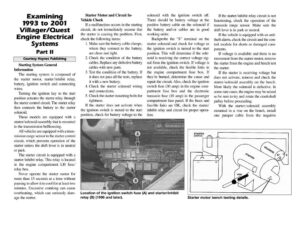
Examining 1993 to 2001 Villager/Quest Engine Electrical Systems Part Il Courtesy Haynes Publishing Starting System General Information The starting system is composed of the starter motor, starter/inhibit relay, battery, ignition switch and connecting wires. Turning the ignition key to the start position actuates the starter relay through the starter control circuit. The starter relay then connects the battery to the starter solenoid. These models are equipped with a starter/solenoid assembly that is mounted to the transmission bellhousing. All vehicles are equipped with a trans- mission range sensor in the starter control circuit, which prevents operation of the starter unless the shift lever is in neutral or park. The starter circuit is equipped with a starter/inhibit relay. This relay is located in the engine compartment LH fuse/ relay box. Never operate the starter motor for more than 15 seconds at a time without pausing to allow it to cool for at least two minutes. Excessive cranking can cause overheating, which can seriously dam- age the starter. Starter Motor and Circuit In- Vehicle Check If a malfunction occurs in the starting circuit, do not immediately assume that the starter is causing the problem. First, check the following items: 1. Make sure the battery cable clamps, where they connect to the battery, are clean and tight. 2. Check the condition of the battery cables. Replace any defective battery cables with new parts. 3. Test the condition of the battery. If it does not pass all the tests, replace it with a new battery. 4. Check the starter solenoid wiring and connections. 5. Check the starter mounting bolts for tightness. If the starter does not activate when the ignition switch is turned to the start position, check for battery voltage to the Location of th relay (B) (1996 and later). e ignition switch fuse (A) and starter/inhibit solenoid with the ignition switch off. There should be battery voltage at the positive battery cable on the solenoid if the battery and/or cables are in good working order. Backprobe the “S” terminal on the starter solenoid and check for voltage as the ignition switch is turned to the start position. This will determine if the sole- noid is receiving the correct voltage sig- nal from the ignition switch. If voltage is not available, check the fusible links in the engine compartment fuse box. If they’re burned, determine the cause and repair the circuit. Also, check the ignition switch fuse (30 amp) in the engine com- partment fuse box and the electronic transaxle fuse (10 amp) in the passenger compartment fuse panel. If the fuses and fusi-ble links are OK, check the starter/ inhibit relay and circuit for proper opera- tion. If the starter/inhibit relay circuit is not functioning, check the operation of the transaxle range sensor. Make sure the shift lever is in park or neutral. If the vehicle is equipped with an anti- theft alarm, check the circuit and the con- trol module for shorts or damaged com- ponents. If voltage is available and there is no movement from the starter motor, remove the starter from the engine and bench test the starter. If the starter is receiving voltage but does not activate, remove and check the starter/solenoid assembly on the bench. Most likely the solenoid is defective. In some rare cases, the engine may be seized so be sure to try and rotate the crankshaft pulley before proceeding. With the starter/solenoid assembly mounted in a vise on the bench, install one jumper cable from the negative STARTER v. Starter motor bench testing details.