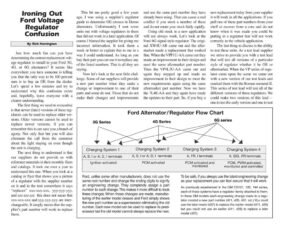
Ironing Out Ford Voltage Regulator Confusion By Rich Herrington Just how much fun can you have determining the correct replacement volt- age regulator to install in your Ford 3G, 4G, or 6G alternators? It seems like everywhere you turn someone is telling you that the only way to be 100 percent sure is to buy an OE from the dealer. Let’s spend a few minutes and try to understand why this confusion exists and, hopefully, leave everyone with a clearer understanding. The first thing we need to remember is that newer (later) versions of these reg- ulators can be used to replace older ver- sions. Older versions cannot be used to replace newer versions. If you can remember this it can save you a bunch of agony. Not only that but you will also eliminate the call from the customer about the light staying on even though the unit is charging. The next thing to understand is that our suppliers do not provide us with reference materials in their monthly fliers and catalogs. It took me over a year to understand this one. When you look at a catalog or flyer that shows you a picture of a regulator with the supplier number on it and in the text somewhere it says “replaces” XXX-XXX-XXX, YYY-YYY-yYy, and zzz-zzz-zzz this does not mean that XXX-XXX-XXX and yyy-yyy-yyy are inter- changeable. It simply means that the sup- plier’s part number will work to replace them. This bit me pretty good a few years ago. I was using a supplier’s regulator guide to determine OE crosses in Denso alternators. Unfortunately I sent some units out with voltage regulators in them that did not work in a later application. Of course I blamed the supplier for giving me incorrect information. It took them a week or better to explain that to me in a way I could understand. As long as you buy their part you can use it to replace any of the listed numbers. That is all they are saying. Now let’s look at the next little chal- lenge. Some of our suppliers will provide a new part number when they make a change or improvement to one of their parts and some do not. Those that do not make their changes and improvements and use the same part number they have already been using. That can cause a real conflict if you stock a number of these and do not rotate your stock fairly rapidly. Using old stock in a new application will not always work. Let’s look at the Ford 6G signal style regulator. The origi- nal XW4U-AB came out and the after- market made a replacement that worked fine. When the VPF1U-AA came out they made an improvement to their design and used the same aftermarket part number. Then the VP4L3U-AA came out and again they stepped up and made an improvement in their design to meet the new requirements again using the same aftermarket part number. Now we have the 7L4E-AA and they again have made the updates to their part. So, if you buy a new replacement today from your supplier it will work in all the applications. If you pull one of these part numbers from your shelf or recover from a core and do not know when it was made you could be putting in a regulator that will not work correctly in the vehicle application. The last thing to discuss is the ability to test these units. As a test lead supplier we strive to provide you with a test lead that will test all versions of a particular style of regulator whether it be OE or aftermarket. When the VP series of regu- lator came upon the scene we came out with a new version of our test leads and marked them with the Roman numeral II. This series of test lead will test all of the different versions of these regulators. We could make two versions of this lead — one to test the early version and one to test Ford Alternator/ Regulator Flow Chart 3G Series 4G Series 6G series Charging System 1 Charging System 2 Charging System 3 Charging System 4 A, S, | or A, D, | terminals A, S, Lor A, D, | terminals A, FR, | terminals A, SIG, FR terminals Ignition activated PCM activated PCM activated and monitored PCM, PWM activated, monitored and controlled Ford, unlike some other manufacturers, does not use the same root number and change the ending digits to signify an engineering change. They completely assign a part number to each change. This makes it more difficult to track these changes. When these changes are made, manufac- turing of the earlier model ceases and Ford simply shows the new part number as a supersession eliminating the old number. Each new model can be used to replace its pred- ecessor but the old model cannot always replace the new. To be safe, if you always use the latest engineering change as your replacement you can feel secure that it will work. As previously experienced in the GM CS121, 120, 144 series, each of these systems have a regulator family attached to them. In these GM models each engineering change made to a regu- lator created a new part number (411, 429, 437, etc.) You could use the later model (437) to replace the earlier model (411, 429) but you could not use an earlier (411, 429) to repl