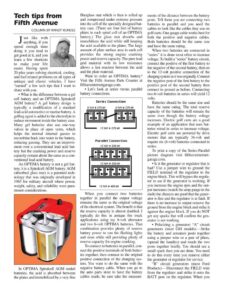
Tech tips from Fifth Avenue COLUMN BY RANDY RUNDLE ust like with anything, if you spend enough time doing it you tend to | — get good at it, and you | | learn a few shortcuts to make your life easier. Having spent 20-plus years solving electrical, cooling, and fuel related problems on all types of antique and classic vehicles, I have “earned” a few tech tips that I want to share with you. e What is the difference between a gel cell battery and an OPTIMA Spiralcell AGM battery? A gel battery design is typically a modification of a standard lead-acid automotive or marine battery. A gelling agent is added to the electrolyte to reduce movement inside the battery case. Many gel batteries also use one-way valves in place of open vents, which helps the normal internal gasses to recombine back into water in the battery, reducing gassing. They are an improve- ment over a conventional lead acid bat- tery but the cranking power and reserve capacity remain about the same as a con- ventional lead acid battery. An OPTIMA battery is not a gel bat- tery, it is a Spiralcell AGM battery. AGM (absorbed glass mat) is a patented tech- nology that was originally developed in 1985 for military aircraft where power, weight, safety, and reliability were para- mount considerations. In OPTIMA Spiralcell AGM sealed batteries, the acid is absorbed between the plates and immobilized by a very fine fiberglass mat which is then is rolled up and compressed under extreme pressure into the cell of the specially designed bat- tery case. (There are four feet of battery plates in each spiral cell of an OPTIMA battery.) The glass mat absorbs and immobilizes the acid while still keeping the acid available to the plates. The large amount of plate surface area in each cell provides the strong engine cranking power and reserve capacity. The pure lead grid material with its low resistance allows a fast reaction between the acid and the plate material. Want to order an OPTIMA battery? Visit the Fifth Avenue Parts Counter at fifthaveinternetgarage.com. ¢ Let’s look at series versus parallel battery connections. Series Connection 6 Yolt @ 225 AH 6 Yolt @ 225 AH 12 Yolt @ 225 AH Parallel Connection 12 ¥Yolt @ 200 AH 12 Yolt @ 200 AH lle ot fe 12 Yolt @ 400 AH When you connect two batteries together in parallel the output voltage remains the same as the original voltage of the electrical system. The benefit is that the reserve capacity is almost doubled. I typically do this in antique fire truck applications using my 6-volt alternator and two 6-volt OPTIMA batteries. That combination provides plenty of reserve battery power to run the flashing lights and siren while still providing plenty of reserve capacity for engine cranking. To connect to batteries in parallel, con- nect the positive terminals of both batter- ies together, then connect to the original positive connection of the charging sys- tem. You want to do the same with the negative battery cable. When you go to the auto parts store to have the battery cables made, be sure take the measure- ments of the distance between the battery posts. Tell them you are connecting two batteries in parallel and you need the cables to look like the cables they use on golf carts. One gauge cable works best for both the positive and negative cables. Both batteries should be the same size and have the same rating. When two batteries are connected in “series” it is done most often to increase voltage. To build a “series” battery circuit, connect the positive of the first battery to the negative of the second battery, then on to the 12-volt positive connection of the charging system as it was originally. Connect the negative post of the first battery to the positive post of the second battery then connect to ground as before. Connecting two 6-volt batteries in series will yield 12 volts. Batteries should be the same size and have the same rating. The total reserve capacity of the batteries will remain the same even though the battery voltage increases. Electric golf carts are a good example of an application that uses bat- teries wired in series to increase voltage. Electric golf carts are powered by drive motors that are typically 36-volt and require six (6-volt) batteries connected in series. To print a copy of the Series-Parallel picture diagram visit fifthaveinternet- garage.com. e Is it the generator or regulator that is bad? Use a jumper wire to ground the FIELD terminal of the regulator to the engine block. This will bypass the regula- tor to see if the generator is working. If you increase the engine rpm and the out- put increases (watch the amp gauge in the dash) the chances are good that the gener- ator is fine and the regulator is at fault. If there is no increase in output remove the ground from the engine block and strike it against the engine block. If you do NOT get any sparks that will confirm the gen- erator is not working. ¢ Polarizing a generator: “A” circuit generators (most GM models)—Strike the