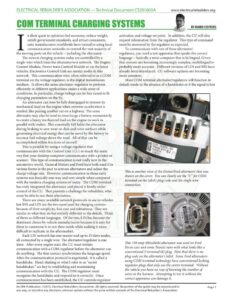
ELECTRICAL REBUILDER’S ASSOCIATION — Technical Document CS201605A www.electricalrebuilders.org COM TERMINAL CHARGING SYSTEMS n their quest to optimize fuel economy, reduce weight, satisfy government standards, and attract consumers, auto manufacturers worldwide have turned to using local communication networks to control the vast majority of the moving parts on the vehicle – including the alternator. The newest charging systems today are controlled by a single-wire which links the alternator to a network. The Engine Control Module, Power-train Control Module or on the latest vehicles, Electronics Control Unit are master nodes in this network. This communication wire, often referred to as a COM terminal on the voltage regulator, is the digital transmission medium. It allows the same alternator-regulator to perform efficiently in different applications under a wide array of conditions. In particular, charge voltage can be fine tuned to fit changing parameters on the fly. An alternator can now be fully disengaged to remove its mechanical load on the engine when extreme acceleration is needed, like passing another car on a highway. The same alternator may also be used to overcharge a battery momentarily to create a heavy mechanical load on the engine to work in parallel with brakes. This essentially full fields the alternator during braking to save wear on disk and rotor surfaces while generating electrical energy that can be saved by the battery to increase fuel mileage down the road. All of that can be accomplished within fractions of second! This is possible by using a voltage regulator that communicates with the Control Unit (CU) in much the same way that your desktop computer communicates with a printer or scanner. This type of communication is not really new in the automotive world. General Motors and Ford have both used it in various forms in the past to activate alternators and adjust the charge voltage rate. However, communication in those early systems was basically one-way and very simple when compared with the modern charging systems of today. The COM terminal has truly integrated the alternator and placed it firmly under control of the CU. That presents a challenge for rebuilders, who must be able to test these alternators. There are many available network protocols in use in vehicles but BSS and LIN are the two most used for charging systems because of their simplicity, low cost and robustness. They are similar in what they do but entirely different in the details. Think of them as different languages. Of the two, LIN has become the dominant choice by vehicle manufacturers because it is easy for them to customize it to suit their needs while making it more difficult to replicate in the aftermarket. Each LIN network has one master and up to 15 slave nodes, all connected by a single wire. The alternator/regulator is one slave. After every engine start, the CU must initiate communication with a COM regulator before the alternator can do anything. The first contact synchronizes the language speed. After the communication protocol is negotiated, it is called a handshake. Hand-shaking or what I refer to as “secret handshakes,” are key to establishing and maintaining communication with the CU. The COM regulator must recognize the handshake and respond to it correctly. Once communication has been established, the CU controls regulator yo BY MARIO CESPEDES activation and voltage set point. In addition, the CU will also request information from the regulator. This type of command must be answered by the regulator as expected. To communicate with one of these alternator/ regulators, you need a test apparatus that speaks the correct language — basically a mini-computer that is bi-lingual. Given that systems are becoming increasingly complex, multilingual is probably more accurate. Different versions of LIN and BSS have already been introduced. CU software updates are becoming more common. Most COM terminal alternator/regulators will function in default mode in the absence of a handshake or if the signal is lost This is another view of the Denso/Ford alternator that was shown on the cover. You can clearly see the “C” for COM terminal on the label’s plug code and the single wire connection. This 150 amp Mitsubishi alternator was used on Ford Focus cars and some Transit vans with what looks like a conventional 3-terminal 6G plug. Note that there is no plug code on the alternator’s label. Some Ford alternators using COM terminal technology have conventional looking regulator plugs that only use the center terminal. Without the vehicle you have no way of knowing the number of wires in the harness. Attempting to test it without the correct apparatus can damage it. An ERA Publication. ©2015, Electrical Rebuilder’s Association. All rights reserved. No portion of the guide may be reproduced in Page 1 any way, or stored in any electronic retrieval system without the prior written consent of the Electrical Rebuilder’s Association.