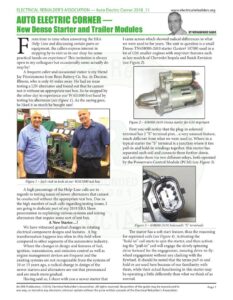
ELECTRICAL REBUILDER’S ASSOCIATION — Auto Electric Corner 2018_11 AUTO ELECTRIC CORNER — New Denso Starter and Trailer Modules rom time to time when answering the ERA Help-Line and discussing certain parts or equipment, the callers express interest in stopping by to visit us in our shop for some practical hands-on experience! This invitation is always open to my colleagues but occasionally some actually do stop by! A frequent caller and occasional visitor is my friend Jay Fitzsimmons from Rexx Battery Co. Inc. in Decatur, Illinois, who is only 45 miles away. He had an issue testing a LIN alternator and found out that he cannot test it without an appropriate test box. So he stopped by the other day to experience our WAI1000 first hand by testing his alternator (see Figure 1). As the saying goes, he liked it so much he bought one! Figure 1 – Jay’ visit to look at our WAI1000 test box A high percentage of the Help-Line calls are in regards to testing issues of newer alternators that cannot be conducted without the appropriate test box. Due to the high number of such calls regarding testing issues, I am going to dedicate part of my 2019 ERA Show presentation to explaining various systems and testing alternators that require some sort of test box. A New Starter…! We have witnessed gradual changes in rotating electrical component designs and features. A big transformation happens less often in this field when compared to other segments of the automotive industry. Where the changes in design and features of fuel, ignition, transmission, and emission control as well as engine management devices are frequent and the existing systems are not recognizable from the systems of 10 or 15 years ago, a radical change in design of the newer starters and alternators are not that pronounced and are much more gradual. Having said so, I share with you a newer starter that www.electricalrebuilders.org BY MOHAMMAD SAMII I came across which showed radical differences in what we were used to for years. The unit in question is a small Denso TN438000-2410 starter (Lester# 10700) used in a lot of GM smaller engines with stop/start features such as late models of Chevrolet Impala and Buick Envision (see Figure 2). Figure 2 – 438000-2410 Denso starter for GM stop/start First you will notice that the plug-in solenoid terminal has 2 “S” terminal pins…a very unusual feature, much different from what we were used to. Where in a typical starter the “S” terminal is a junction where it ties pull-in and hold-in windings together, this starter has separated each coil and connects them further down, and activates them via two different relays, both operated by the Powertrain Control Module (PCM) (see Figure 3). ¥ terminals Figure 3 – 438000-2410 Solenoid’ “S” The starter has a soft start feature, thus the reasoning for separated coils (see Figure 4). Activating the “hold-in” coil starts to spin the starter, and then activat- ing the “pull-in” coil will engage the slowly spinning drive forward for the engagement, insuring drive-to-fly- wheel engagement without any clashing with the flywheel. It should be noted that the terms pull-in and hold-in are used here because of our familiarity with them, while their actual functioning in this starter may be operating a little differently than what we think of as normal. An ERA Publication. ©2018, Electrical Rebuilder’s Association. All rights reserved. No portion of the guide may be reproduced in Page 1 any way, or stored in any electronic retrieval system without the prior written consent of the Electrical Rebuilder’s Association. ELECTRICAL REBUILDER’S ASSOCIATION — Auto Electric Corner 2018_11 www.electricalrebuilders.org AUTO ELECTRIC CORNER Starter Pinion Solenoid Actuation Relay Starter Relay po raed Figure 4 – PCM-operated sequential starter relays What is also radically different is the commutator and brushes. They are both narrowly grooved to increase brush-to-commutator contact surface (see Figure 5), thus no machining and polishing of the commutator is required or necessary. It is a feature that distinctly separates this starter from what we have been used to during all of our careers. The brush springs are very strong and the positive brush leads are short enough to make loading the brushes a little difficult. Figure 5 – Grooved armature commutator and brush The higher reduction ratio (5.6:1) make the starter seem to be turning slower than usual, but the larger diameter drive gear (approximately 37mm in diameter) has 15 teeth that compensates and turns the engine at an appropriate speed. As of yet there are no service parts that I am aware of but Iam sure when the demand increases some service part might be available. The aftermarket is also looking into their version of the replacement unit but as of this writing there are none on the market. So far the availability is through the dealership with pricing based on their location. They might charge as much as 400 to 600 dollars, but these vehicles are still under warranty and there is not much chance of starter or alternator work for the aftermarket rebuilder. Rebuilding this unit might be a straight-forward process but a little more complex. The unusual groves on the armature and brushes will certainly create challenges that need to be experienced and will be addressed in time. A detailed explanation of operation of this PCM activated starter with complete break-down and pictorial is planned to be presented at the 2019 ERA Show. Trailer Plug Module As an auto electric shop that repairs wiring, locates shorts, traces battery drains, and repairs lighting systems, it is routine and at times a considerable part of our business. Along the same lines, we also repair trailer wiring, a good portion of our wiring work that caters mainly to contractors of various sorts who have trailers to haul their various pieces of equipment. Their trailer-to-truck connector, either a 4-wire flat connector or a 7-wire round one that in some systems provides power for the electric trailer brakes has been a common item for decades. But due to some changes in vehicle lighting, we are now seeing changes which invariably result in some challenges. The common type of set-up in a vehicle was (and still is in most) that the brake and turn signals share the same filament of the light bulb. So when a turn signal and brake light were both being used, the appropriate side stop-light would turn into a flashing turn signal. The typical trailers are also wired in the same manner, so connecting the trailer to the truck was simple, using adaptors, splicing the appropriate wires, or using T-connectors in the truck’s wiring harnesses to make a connection point for the trailer connector. Since the newer vehicles mostly use separate light bulbs for turn and stop lights independent of each other, then the connection of such vehicles to the ordinary trailer requires the addition of a converter to adapt the vehicle wiring (ones with separate stop and turn light) into the one with shared stop and brake light to feed the trailer. These converters or modules that contain their own electronics may also have their own direct B+ feed from the battery that needs to be connected. These modules/ adaptors can develop their own set of problems that can manifest itself by blowing fuses, draining batteries, causing unusual or no lighting or an assortment of other headaches. We have seen many cases where these modules create a battery drain which goes away when the trailer-to-truck connector is disconnected, or sometimes develop visible damage that is a tell-tale sign of an internal failure (see Figure 6). An ERA Publication. ©2018, Electrical Rebuilder’s Association. All rights reserved. No portion of the guide may be reproduced in Page 2 any way, or stored in any electronic retrieval system without the prior written consent of the ElectricalPRebuilder’s Association.