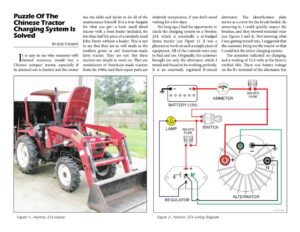
Puzzle Of The Chinese Tractor Charging System Is Solved BY BOB THOMAS t is easy to see why someone with limited resources would buy a Chinese compact tractor, especially if its planned use is limited and the owner Figure 1—Nortrac 254 tractor has the skills and desire to do all of the maintenance himself. It is a true bargain for what you get—a basic small diesel tractor with a front loader included, for less than half the price ofa similarly sized John Deere without a loader. This is not to say that they are as well made as the modern green or red American-made farm tractor. They are not. But these tractors are simple to work on. They are reminiscent of American-made tractors from the 1960s, and their repair parts are relatively inexpensive, if you don’t mind waiting for a few days. Not long ago, I had the opportunity to check the charging system on a Nortrac 254, which is essentially a re-badged Jinma tractor (see Figure 1). It was a pleasure to work on sucha simple piece of equipment. All of the controls were easy to find and use. Originally, the customer brought me only the alternator, which I tested and found to be working perfectly. It is an externally regulated B-circuit – + Oo00000 AMMETER BATTERY (12V) LAMP 10AATO REGULATOR Figure 2—Nortrac 254 wiring diagram alternator. The identification plate serves as a cover for the brush holder. By removing it, I could quickly inspect the brushes, and they showed minimal wear (see Figures 3 and 4). Not knowing what I was getting myself into, I suggested that the customer bring me the tractor so that I could test the entire charging system. The ammeter indicated no charging, and a reading of 12.6 volts at the battery verified this. There was battery voltage on the B+ terminal of the alternator, but 30A ATO FUSE ALTERNATOR 2013-09 WSG there was no voltage on the field terminal with the engine running. It was easy to locate the electronic voltage regulator, which plugged into the side of the fuse panel (see Figure 5). After testing the fuses (which are clearly labeled) for the alternator and the regulator, I removed the regulator, identified the terminals (which are labeled on the back) checked the B+ terminal in the regulator terminal block to verify that it had voltage and jumped it to field. The alternator began charging! So the regulator must be bad, right? To be sure, I tested the regulator, using a VR101 Transpo regulator tester, and it worked perfectly off the tractor -(see Figure 6). What did I miss? I re-tested all of the terminals in the regulator terminal block, which is identical to the most common five-pin relay plug used with Bosch-style relays. The B+ terminal is actually an ignition terminal which turns the regulator on (see Figure 2). It also serves as the sense terminal. But when I probed the ground wire, I noticed that it was loose in the terminal block. Could the problem be that simple? I plugged the regulator back into the terminal block while pushing on the ground wire from the rear. The alternator immediately began charging normally. I removed the ground wire from the terminal block and bent the tang (to ensure a good connection). This fixed the charging system—no parts required! A little research showed that the alternator and the regulator are both available from several Chinese tractor distributors at reasonable prices. The alternator itself is simple, low amperage and very likely to last a long time. In a pinch, a standard electronic Ford voltage regulator could be used with this system without any major wiring changes. Wikipedia Facts: The Jinma tractor brand is a product of the Jiangsu Yueda Tractor Manufacturing Company of China. The company was born out of the Jiangsu Yueda Yancheng Tractor Factory, established in 1959 as a Chinese state-owned company of the Machinery Ministry. The company makes the Jinma brand of small (20-75 horsepower) wheeled tractors, in addition to the Huanghai brand of walking tractors. Jinma tractors are exported to Southeast Asia, the Middle East, Europe, and North America. In the United States, Jinma tractors are assembled and resold under a variety of brand names including Nortrac, Agracat, Farmpro, and Emerybuilt. Figure 3—Nortrac alternator Figure 4—Nortrac alternator with inspection plate removed. Cie TRANSPO ee A Ac CIRCUIT ) ° MODEL # VAC 101 go * =? BATTERY Dy da POSITIVE i W sBATTERY 4 . NEGATIVE ; Figure 5—The Nortrac fuse and relay panel. Figure 6—Testing the Nortrac voltage regulator.