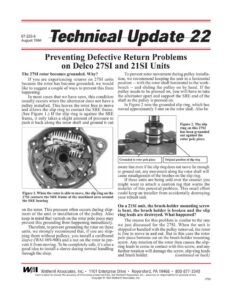
87-229-6 August 1994 Preventing Defective Return Problems on Delco 27SI and 21SI Units The 27SI rotor becomes grounded. Why? If you are experiencing returns on 27SI units because the rotor has become grounded, we would like to suggest a couple of ways to prevent this from happening. In most cases that we have seen, this condition usually occurs when the alternator does not have a pulley installed. This leaves the rotor free to move and allows the slip ring to contact the SRE frame. (See Figure 1.) If the slip ring is against the SRE frame, it only takes a slight amount of pressure to push it back along the rotor shaft and ground it out Figure 1. When the rotor is able to move, the slip ring on the 27SI contacts the SRE frame at the machined area around the SRE bearing on the rotor. This pressure often occurs during ship- ment of the unit or installation of the pulley. Also keep in mind that varnish on the rotor pole piece may prevent this grounding from happening immediately. Therefore, to prevent grounding the rotor on these units, we strongly recommend that, if you are ship- ping them without pulleys, you install a cardboard sleeve (WAI #89-900) and a nut on the rotor to pre- vent it from moving. To be completely safe, it’s also a good idea to install a sleeve during normal handling through the shop. To prevent rotor movement during pulley installa- tion, we recommend keeping the unit in a horizontal position — with the rotor shaft horizontal to the work- bench — and sliding the pulley on by hand. If the pulley needs to be pressed on, you will have to take the alternator apart and support the SRE end of the shaft as the pulley is pressed on. In Figure 2 note the grounded slip ring, which has moved approximately 3 mm on the rotor shaft. Also be Figure 2. The slip ring on this 27SI has been grounded out against the rotor pole piece. aware that even if the slip ring does not move far enough to ground out, any movement along the rotor shaft will cause misalignment of the brushes on the slip ring. If these units are being sold over the counter you might want to attach a caution tag that warns the installer of this potential problem. This small effort could keep an installer from accidentally destroying your rebuilt unit. On a 21S] unit, the brush-holder mounting screw is bent, the brush holder is broken and the slip ring leads are destroyed. What happened? The reason for this problem is similar to the one we just discussed for the 27SI. When the unit is shipped or handled with the pulley removed, the rotor is free to move in and out. But in this case the rotor pole piece bottoms out on the brush-holder mounting screw. Any rotation of the rotor then causes the slip- ring leads to come in contact with this screw, and any further rotation will damage the screw, slip-ring leads and brush holder. (continued on back) / Wl Wetherill Associates, Inc. + 1101 Enterprise Drive + Royersford, PA 19468 – 800-877-3340 Care is taken to ensure the accuracy of information presented here, but Wetherill Associates, Inc., assumes no responsibility for possible errors. Copyright © 1994 Wetherill Associates, Inc. 3752 To prevent this problem be very careful when you are removing or installing the pulley that the impact wrench does not spin the rotor when it is in the inward position. In addition, as with the 27SI, when you are shipping these units or moving them through the shop without pulleys, we recommend installing a cardboard sleeve (WAI #89-900) and a nut on the rotor to prevent the slip-ring lead from coming in contact with the brush holder. (See Figure 3.) Brush-holder mounting screw Slip ring lead Slip ring lead — Figure 3. On the 21SI, the rotor can move inward, causing damage to the slip ring leads, the brush-holder mounting screw and brush holder.