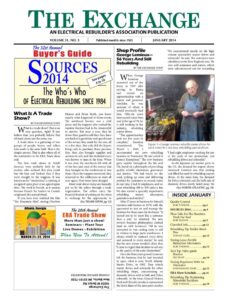
THE EXCHANGE AN ELECTRICAL REBUILDER’S ASSOCIATION PUBLICATION VOLUME 31,NO.5 | Published monthly since 1983 | JANUARY 2014 The 31st Annual Buyer’s Guide The Who’s Who OF ELECTRICAL REBUILDING SINCE 1984 What Is A Trade Show? BY THE EXCHANGE STAFF hat is a trade show? That is an easy question, right? If you believe that, you probably believe that all trade shows are the same, too. A trade show is a gathering of two groups of people, buyers and sellers, who work in the same field. That is the simple answer. That is also where all of the similarities to the ERA Trade show end. The first trade shows in North America were probably held by fur traders, who realized that they could buy the best and freshest furs if they went straight to the trappers. It was known as the “rendezvous”, a meeting at an agreed upon place at an agreed upon time. The word is French, as it sounds, because French fur traders in Canada originated this annual ritual. If you have ever watched the film “The Mountain Men’, staring Charlton Heston and Brian Keith, you know exactly what happened at those events. The northwest frontier was a wild place, and the trappers who worked the western Rockies had to be resourceful to survive. But once a year, they let down their guard to sell their furs, have one heck of a good time and spend most of the money they made for the year, all in a few days. Not only did the buyers bring cash to purchase those precious furs, they also brought supplies and services to sell, and that included every vice known to man at the time. When it was over, the merchants left with all of the furs and most of the money that they brought to the rendezvous to buy them. Once the trappers recovered, they returned to the wilderness to start all over again. How times have changed. Most trade shows today are basically put on by the sellers through a trade organization. The sellers carry the financial burden of putting on the show, in exchange for the opportunity to (See TRADE SHOW, pg. 12) The 26th Annual ERA Trade Show More than just a show! Seminars « Plant Tour Live Demos « Exhibition Plaat Now To -bttead! GALSANDAY ADIANAS SONVHO SEEL-LSLES IM ‘UIL8q MON Pu HOl8g M 0691 aBueyoxy eu Shop Profile George Lemieux— 56 Years And Still Rebuilding BY THE EXCHANGE STAFF hen George Lemieux mustered out of the Army in 1957 after serving in Korea, and started an apprenticeship with a starter and generator rebuilder, he was unaware of where it would eventually lead him. Fifty-six years have passed since then, and at the age of 78, he is still working in the industry, rebuilding starter drives. “The apprenticeship took me five years to complete,” Lemieux remembered. “On March 1, 1963, I incorporated my own _ rebuilding business in Pawtucket, RI and called it Gemco Enterprises.” The new business grew rapidly throughout the 60s and 70s, based on a philosophy of providing quality reliable alternators, generators and starters. “We had trucks on the road, picking up cores and delivering product for customers in several states. At one time, I had 50 employees, and we were rebuilding 400 to 500 units a day. We also started a specialty department, rebuilding import alternators, generators and starters.” After 17 years in business for himself, Lemieux sold Gemco in 1979, with the agreement to stay on and manage the business for three years for the buyer. “It turned out to be more like a sentence than a job” he admitted. The new owner’s business philosophies clashed head on with Lemieux’s. “All he was interested in was cutting costs to sell in volume to large parts warehouses. I always rebuilt or replaced every drive and solenoid in every starter,” he said. But the new owner wouldn’ allow that. “T came to regret that decision to sell out, as the quality of the units diminished” Once the three years passed, Lemieux left the business that he had founded, to open, what is now, North Atlantic Starter Drive, in 1982. They rebuilt starter drives and solenoids for other rebuilding shops, concentrating on domestic drives sold in bulk and Delco solenoids. At the time, General Motors, Ford and Chrysler products represented the lion’s share of the auto parts market. “We concentrated mostly on the high volume automotive starter drives and solenoids,” he said. His customers were rebuilders in the New England area. He also sold armatures and stators, which were subcontracted out for rewinding. Figure 1—George Lemieux rebuilds starter drives for stock when he’s not busy rebuilding special drives. “I had eight employees working for me at the peak of our production, just rebuilding drives and solenoids.” As the Japanese car market grew in the US, the demand for import drives increased. Lemieux saw that coming and filled the need by rebuilding import drives. At the same time, the demand for Delco solenoids and the bulk sale of domestic drives slowly faded away. He (See NORTH ATLANTIC, pg. 18) INSIDE JANUARY Quality Control BOB THOMAS }..cccsseeseeeeees pg.2 SOURCES 20