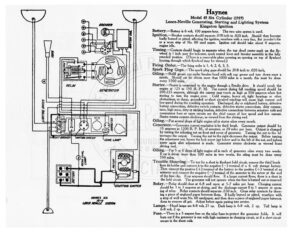
GBS H 4 ae in ——————— Haynes Model 45 Six Cylinder (1919) Leece-Neville Generating, Starting and Lighting System Kingston Ignition Battery.—Battery is 6 volt, 100 ampere-hour. The two wire system is used. Ignition.—Breaker contacts should separate .018 inch to .020 inch. Should they become badly burned or pitted, affecting the ignition, resurface with a very fine, flat jeweler’s file or a worn strip of No. 00 sand paper. Ignition coil should take about 4 amperes, engine idle. Timing.—Contacts should begin to separate when the top dead center mark on the fly- wheel is I inch past the indicator, spark control lever and breaker assembly in the fully retarded position. (There is a removable plate covering an opening on top of flywheel housing, through which flywheel may be viewed.) Firing Order.—The firing order is 1, 4, 2, 6, 3, 5. Spark Plug Gaps.—The spark plug gaps should be .018 inch to .020 inch, Oiling.—Refill grease cup under breaker head with soft cup grease and tum down once a month, Should car be driven more than 1000 miles in a month, this must be done every 1000 miles. Starter.—Starter is connected to the engine through a Bendix drive. It should crank the engine at 125 to 150 R. P. M. The current during full cranking speed should be 200-225 amperes, although the current may reach as high as 550 amperes when first starting to tum the engine over. Cold engine, heavy oil, tight bearings or other obstructions, or damp, grounded or short circuited windings will cause high current and low speed during the cranking operation. Discharged, dry or sulphated battery, defective attery connections, defective switch contacts, defective starter connections, dirty commu- tator, high mica, dirty or sticking brushes, defective connections between armature coils and commutator bars or open circuits are the chief causes of low speed and low current. Starter rotates counter-clockwise, as viewed from the driving end. Oiling.—Put several drops of light engine oil in starter oilers every month. Generator.—Generator current regulation is by third brush. Generator output should be 15 amperes at 1200 R. P. M., of armature, or 20 miles per hour. Output is changed by turning the adjusting nut on front end cover of generator. Turning the nut to the lef increases the output. Turning the nut to the right decreases the output. Before tuming the adjustment nut, loosen the lock screw just below and to the left of the nut, and tighten screw again after adjustment is made. Generator rotates clockwise as viewed fromt iving end, Oiling.—Put 5 or 6 drops of light engine oil in each of generator oilers every two weeks. car is driven more than 500 miles in two weeks, the oiling must be done every 500 miles. ‘Trouble Shooting.—To test for a short in theshunt field circuit, remove the third brush from its holder and connect it to the negative (—) terminal of a 6 volt storage battery. Then connect the positive (++) terminal of the battery to the positive (++) ‘erminal of an ammeter and connect the negative (—) terminal of the ammeter to the screw at the end of the fuse clip. Four amperes should flow. _ If a larger current flows, there is a short in the field circuit. The generator will not operate when the fuse is burned out or removed Relay.—Relay should close at 6-8 and open at 5-7 miles per hour. Charging current should be | to 3 amperes at closing, and the discharge current 0 to | ampere at opens ing of relay. Relay contacts should separate .030 inch. Clean relay contacts by draw- ing a piece of unglazed paper between them. If badly burned or pitted, resurface with a strip of well worm No. 00 sandpaper, and then draw a piece of unglazed paper between them to remove all grit. Adjust before again putting into service. Lamps.—Head lamps are 6-8 volt, 21 cp. Dash lamp is 6-8 volt, 2 cp. Tail lamp is 6-8 volt, 2 cp. Fuse.—There is a 5 ampere fuse on the relay base to protect the generator fields. It will bum out if the generator is run with high resistance in charging circuit, or if a short circuit occurs in the shunt coils.