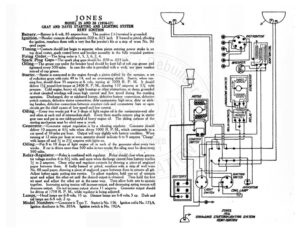
JONES MODEL 25 AND 26 (1916-17 GRAY AND DAVIS STARTING AND LIG G SYSTEM REMY IGNITION Battery.—Battery is 6 volt, 85 ampere-hour. The positive (++) terminal is grounded. Ignition.—Breaker contacts should separate .020 to .025 inch If burned or pitted, affecting the ignition, resurface them with a very fine flat jeweler’s file or a strip of worn No. 00 sand paper. Timing.—Contacts should just begin to separate when piston entering power stroke is on top dead center, spark control lever and breaker assembly in the fully retarded position. Firing Order.—The firing order is 1, 5, 3, 6, 2, 4. Spark Plug Gaps—The spark plug gaps should be .020 to .025 inch. Oiling.—The grease cup under the breaker head should be kept full of soft cup grease and tightened every 500 miles. In case the oiler is provided with a wick, use pure vaseline instead of cup grease. Starter.—Starter is connected to the engine through a pinion shifted by the operator, a set of reduction gears with ratio 49 to 14, and an overrunning clutch. Starter, when run- ning free, should draw 35 amperes at 6 volts, turning at 7000 R. P. M. It should deliver 114 pound-feet torque at 2400 R. P. M., drawing 137 amperes at 534 volts pressure. Cold engine, heavy oil, tight bearings or other obstructions, or damp, grounded or short circuited windings will cause high current and low speed dunng the cranking operation. Discharged, dry or sulphated battery, defective battery connections, defective switch contacts, defective starter connections, dirty commutator, high mica, dirty or stick- ing brushes, defective connections between armature coils and commutator bars or open circuits are the chief causes of low speed and low current. Oiling.—Every two weeks put 4 or 5 drops of light engine oil in the commutator-end oiler and oilers at each end of intermediate shaft. Every three months remove plug in starter gear case and put in one tablespoonful of heavy engine oil. The sliding surfaces of the starting mechanism must be oiled once a week. Generator.—Generator output regulation is by a vibrating regulator. Generator should deliver 10 amperes at 61% volts when driven 1000 R. P. M., which corresponds to a car speed of 10 miles per hour. Output will vary slightly with battery condition. When running at 12 miles per hour or over, ammeter should indicate 6 to 9 amperes “Charge” with lamps off and 4 to 244 amperes with lights on. Oiling.—Put 8 to 10 drops of light engine oil in each of the generator oilers every two weeks. If car is driven more than 500 miles in two weeks, the oiling must be done every Relay-Regulator.—Relay is combined with regulator. Relay should close when genera- tor voltage reaches 6 to 614 volts, and open when discharge current from battery reaches Y% to 2 amperes. Clean relay and regulator contacts by drawing a piece of unglazed paper between them. If badly bumed or pitted, resurface with a strip of well worn No. 00 sand paper, drawing a piece of unglazed paper between them to remove all grit. Adjust before again putting into service. To adjust regulator, hold one set of contacts apart and adjust the other set until the desired output is obtained. Then hold the first set apart and adjust the other set in the same way. Then allow both sets to operate together. Increasing spring tension will increase output, and decreasing spring tension will decrease output. Do not increase output above || amperes. Generator output should be driven at 1750 R. P. M., while regulator is being adjusted. Lamps.—Head lamps are 6-8 volts, 15 cp. Dimmer lamps are 6-8 volts, 5 cp. Dash and tail lamps are 6-8 volt, 2 cp. | . Model Numbers.—Generator is Type T. Starter is No. 136. Ignition coil is No. 175A. Ignition distributor is No. 203A. Ignition switch is No. 192A. qnd Blonds “Tale, GRAYHDAVIS STARTINGILIGHTING SYSTEM REMY [GNITION