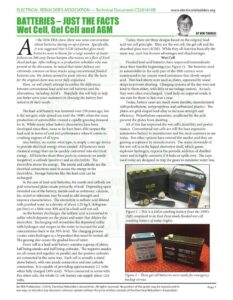
ELECTRICAL REBUILDER’S ASSOCIATION — Technical Document CS201610B www.electricalrebuilders.org BATTERIES — JUST THE FACTS Wet Cell, Gel Cell and AGM t the 2016 ERA show, there was some conversation about batteries during an open forum. Specifically, it was suggested that AGM (absorbed glass mat) batteries were to blame for a large number of stator failures on 200 amp Denso hairpin alternators on a fleet of Ford diesel pickups. After talking to a production rebuilder who was present at the discussion, he stated that stator failures are extremely common on these trucks using conventional flooded batteries too. The debate seemed to peak interest. But the basis for the original claim was never fully explained. Here, we will simply attempt to outline the differences between conventional lead-acid wet cell batteries and the alternatives, including AGM’s. Hopefully this will help to help you better serve your customers in choosing the battery best suited to fit their needs. The lead-acid battery was invented over 150 years ago, but it did not gain wide spread use until the 1900’s when the mass production of automobiles created a rapidly growing demand for it. While many other battery chemistries have been developed since then, none so far have been able surpass the lead-acid in terms of cost and performance when it comes to cranking engines of all types. Any battery, no matter what type, is simply a storage device to provide electrical energy when needed. All batteries store chemical energy that can be quickly converted into electrical energy. All batteries share three parts in common: an anode (negative), a cathode (positive) and an electrolyte. The electrolyte stores the energy. The anode and cathode are the electrical connections used to access the energy in the electrolyte. Storage batteries like the lead-acid can be recharged. In the case of lead-acid batteries, the anode and cathode are grid-structured plates made primarily of lead. Depending upon intended use of the battery, metals such as antimony, calcium, tin, nickel or selenium may be used to add strength and improve characteristics. The electrolyte is sulfuric acid diluted with purified water to a density of about 1.25 kg/L (kilogram per liter) or a little over 30% acid in a lead-acid wet cell. As the battery discharges, the sulfuric acid is converted to sulfur which deposits on the plates and water that dilutes the electrolyte. Recharging will recombine the deposited sulfur with hydrogen and oxygen in the water to increase the acid concentration back to the 30% level. The charging process creates extra hydrogen as a byproduct that must be vented off. The gassing also causes the gradual loss of water. Every cell in a lead-acid battery contains a group of plates, half being anodes and half being cathodes. The negative anodes are all connected together in parallel and the positive cathodes are connected in the same way. Each cell is actually a stand alone battery, with one anode connection and one cathode connection. It is capable of providing approximately 2.1 volts when fully charged (30% acid). When connected in series with five other cells, the whole 12 volt battery can supply about 12.6 volts. Bcwcal BY BOB THOMAS Today, there are three designs based on the original lead- acid wet cell principle. They are the wet cell, the gel cell and the absorbed glass mat (AGM). While they all function basically the same way, each has its own advantages and disadvantages. Wet Cell Flooded lead-acid batteries have improved tremendously since their humble beginnings (see Figure 1). The batteries used in automobiles in the early part of the 20th century were constructed in tar-coated wood containers that slowly seeped acid. Thin lead sheets were used as plates, separated by wood strips to prevent shorting. Charging systems of the day were not kind to them either, with little or no voltage control. As such they were often overcharged. Used daily on unpaved roads, it was rare for them to last over a year. Today, battery cases are much more durable, manufactured with polyethylene, polypropylene and carbonized plastics. The plates are grid-shaped lead alloy to increase strength and efficiency. Polyethylene separators, unaffected by the acid, prevent the plates from shorting. All of this has improved the wet cell’s durability and perfor- mance. Conventional wet cells are still the least expensive automotive battery to manufacture and the most common in use today. But other options have entered the market and they are gaining acceptance by manufacturers. The major downside of the wet-cell is in the liquid electrolyte itself, which gasses explosive hydrogen, requires the periodic addition of distilled water and is highly corrosive if it leaks or spills over. The caps used today are designed to trap the gases to minimize water loss. Figure 1 – This is a Delco cranking battery from the 1950’s (left) compared to an East Penn made flooded wet cell cranking battery of today (right). Figure 2 – These gel cell batteries were made for emergency backup service. An ERA Publication. ©2016, Electrical Rebuilder’s Association. All rights reserved. No portion of the guide may be reproduced in Page 1 any way, or stored in any electronic retrieval system without the prior written consent of the Electrical Rebuilder’s Association.