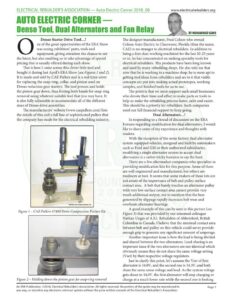
ELECTRICAL REBUILDER’S ASSOCIATION — Auto Electric Corner 2018_08 www.electricalrebuilders.org AUTO ELECTRIC CORNER — Denso Tool, Dual Alternators and Fan Relay Denso Starter Drive Tool…! ne of the great opportunities of the ERA Show was seeing exhibitors’ parts, tools and equipment, giving attendees the chance to see the latest, but also enabling us to take advantage of special pricing that is usually offered during each show. That is how I came across this clever little tool and bought it during last April’s ERA Show (see Figures 1 and 2). It is made and sold by CAE Pullers and is a real time-saver for replacing the snap-ring, collar, and pinion used on Denso reduction gear starters. The tool presses and holds the pinion gear down, thus freeing both hands for snap-ring removal using whatever suitable tool that you may have. It is also fully adjustable to accommodate all of the different sizes of Denso drive assemblies. The manufacturers’ website (www.caepullers.com) lists the details of this and a full line of sophisticated pullers that the company has made for the electrical rebuilding industry. ‘Sammy’s Auto Electric Service, Inc. Figure 1 – CAE Pullers #7400 Drive Compression Fixture Kit Figure 2 – Holding down the pinion gear for snap-ring removal BY MOHAMMAD SAMII The designer/manufacturer, Fred Colson who owned Colson Auto Electric in Clearwater, Florida (thus the name, CAE) is no stranger to electrical rebuilders. In addition to being a first class working machinist for the last 20-25 years or so, he has concentrated on making specialty tools for electrical rebuilders. His products have been long known and used by many rebuilding shops. He also told me that now that he is working in a machine shop, he is more apt to getting tool ideas from rebuilders and see to it that viable concepts are put into making actual prototypes, working samples, and finished tools for us to use. The point is that we must support such small businesses who devote their time and effort to make parts or tools to help us make the rebuilding process faster, safer and easier. This should be a priority for rebuilders. Such companies need our full financial support to keep going. Dual Alternators…! In responding to a thread of discussion on the ERA Forums regarding modification for dual alternators, I would like to share some of my experience and thoughts with readers. With the exception of the some factory dual alternator system equipped vehicles, designed and built by automakers such as Ford and GM or their authorized subsidiaries, modifying a single alternator system to accept dual alternators is a rather tricky business to say the least. There are a few aftermarket companies who specialize in providing modification kits for this purpose. Some of them are well engineered and manufactured, but others are mediocre at best. It seems that some makers of these kits are not aware of the importance of belt and pulley surface contact area. A belt that barely touches an alternator pulley with very low surface contact area cannot provide very much additional output, not to mention that the heat generated by slippage rapidly increases belt wear and overheats alternator bearings. A good example of this can be seen in this picture (see Figure 3) that was provided by our esteemed colleague Nathan Unger of A.S.I. Rebuilders of Abbotsford, British Colombia in Canada. I believe that the minimal contact area between belt and pulley on this vehicle could never provide enough grip to generate any significant amount of amperage. Another important issue is how the load is being divided and shared between the two alternators. Load-sharing is an important issue if the two alternators are not identical which obviously means they do not share the same voltage setting (Vset) by their respective voltage regulators. Just to clarify this point, let’s assume the Vset of first alternator is 14.0V, and the second one is 14.3V, and both share the same sense voltage and load. As the system voltage gets closer to 14.0V, the first alternator will stop charging or charge at a much lower rate while the second one is looking An ERA Publication. ©2018, Electrical Rebuilder’s Association. All rights reserved. No portion of the guide may be reproduced in Page 1 any way, or stored in any electronic retrieval system without the prior written consent of the Electrical Rebuilder’s Association.