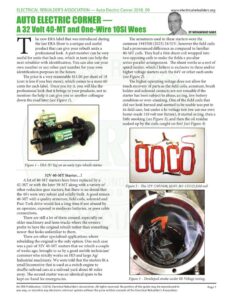
ELECTRICAL REBUILDER’S ASSOCIATION — Auto Electric Corner 2018 09 www.electricalrebuilders.org AUTO ELECTRIC CORNER — A 3S2 Volt 40-MT and One-Wire 10SI Woes he new ERA label that was introduced during the last ERA Show is a unique and useful product that can give your rebuilt units a professional look. A part number can be very useful for units that lack one, which in turn can help the next rebuilder with identification. You can also use your own number or any other part number for your own identification purposes in the future. The price is a very reasonable $11.00 per sheet of 18 (cost is less if you buy more), which comes to a mere 60 cents for each label. Once you try it, you will like the professional look that it brings to your products, not to mention the help it can give you or another colleague down the road later (see Figure 1). Figure 1 – ERA ID Tag on an early type rebuilt starter. 32V 40-MT Starter…! A lot of 40-MT starters have been replaced by a 42-MT or with the later 39-MT along with a variety of other reduction gear starters, but there is no denial that the 40’s were very robust and solidly built. A good reman 40-MT with a quality armature, field coils, solenoid and Posi-Tork drive would last a long time if not abused by an operator, exposed to mediocre batteries, or poor cable connections. There are still a lot of them around, especially on older machinery and farm trucks where the owners prefer to have the original rebuilt rather than something newer that looks unfamiliar to them. There are other specialized applications where rebuilding the original is the only option. One such case was a pair of 32V 40-MT starters that we rebuilt a couple of weeks ago, brought to us by a good mobile technician/ customer who strictly works on HD and large Ag/ Industrial machinery. We were told that the starters fit a small locomotive that is used as a switch engine to shuffle railroad cars at a railroad yard about 40 miles away. The second starter was an identical spare to be kept on-hand for emergencies. J ‘“ BY MOHAMMAD SAMI The armatures used in these starters were the common 1945500 (2023) 24/32V, however the field coils had a pronounced difference as compared to familiar 40-MT coils. They had a thin shunt coil wrapped into two opposing coils to make the fields a peculiar series-parallel arrangement. The shunt works as a sort of speed limiter, which I believe is exclusive to these and/or higher voltage starters such the 64V or other such units (see Figure 2). The higher operating voltage does not allow for much recovery of parts as the field coils, armature, brush holder and solenoid contacts are not reusable if the starter has been subject to abuse, arcing, low battery condition or over-cranking. One of the field coils that did not look burned and seemed to be usable was put in its field case, but under a hi-voltage test (we use our own home-made 110 volt test fixture), it started arcing, then a little smoking (see Figure 3), and then the oil residue soaked up by the coils caught on fire! (see Figure 4) | 4 Figure 3 – Developed smoke under Hi- Voltage testing. An ERA Publication. ©2018, Electrical Rebuilder’s Association. All rights reserved. No portion of the guide may be reproduced in Page 1 any way, or stored in any electronic retrieval system without the prior written consent of the Electrical Rebuilder’s Association.