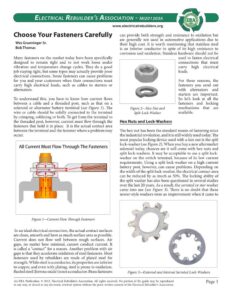
ELecTRICAL REBUILDER’S ASSOCIATION – MI201303A www.electricalrebuilders.org Choose Your Fasteners Carefully Wes Grueninger Sr. Bob Thomas Many fasteners on the market today have been specifically designed to remain tight and to not work loose under vibration and temperature change cycles. They do a good job staying tight, but some types may actually provide poor electrical connections. Some fasteners can cause problems for you and your customers when their connections must carry high electrical loads, such as cables to starters or alternators. To understand this, you have to know how current flows between a cable and a threaded post, such as that on a solenoid or alternator battery terminal (see Figure 1). The wire or cable should be solidly connected to the terminal by crimping, soldering or both. To get from the terminal to the threaded post, however, current must flow through the fasteners that hold it in place. It is the actual contact area between the terminal and the fastener where a problem may occur. All Current Must Flow Through The Fasteners Figure 1—Current Flow Through Fasteners In an ideal electrical connection, the actual contact surfaces are clean, smooth and have as much surface area as possible. Current does not flow well between rough surfaces. Air gaps, no matter how minimal, cannot conduct current. It is called a “contact” for a reason. Another problem with air gaps is that they accelerate oxidation of steel fasteners. Most fasteners used by rebuilders are made of plated steel for strength. While steel is a conductor, its properties are inferior to copper, and even with plating, steel is prone to oxidation. Rusted steel (ferrous oxide) is nota conductor. Brass fasteners An ERA Publication. © 2013, Electrical Rebuilder’s Association. All rights reserved. No portion of the guide may be reproduced can provide both strength and resistance to oxidation but are generally not used in automotive applications due to their high cost. It is worth mentioning that stainless steel is an inferior conductor in spite of its high resistance to corrosion and oxidation. Stainless hardware should not be used to fasten electrical connections that must carry high electrical loads. ES For these reasons, the fasteners you send out with alternators and starters are important. So let’s look at all the fasteners and_ locking mechanisms that are available. Figure 2—Hex Nut and Split Lock- Washer Hex Nuts and Lock-Washers The hex nut has been the standard means of fastening since the industrial revolution, and it is still widely used today. The most popular locking device used with a hex nut is the split lock-washer (see Figure 2). When you buy a new aftermarket solenoid today, chances are it will come with hex nuts and split lock-washers. It may be acceptable to use a split lock- washer on the switch terminal, because of its low current requirements. Using a split lock-washer on a high-current battery post, however, can cause problems. Depending on the width of the split lock-washer, the electrical contact area can be reduced by as much as 50%. The locking ability of the split washer has also been questioned in several studies over the last 20 years. As a result, the serrated or star washer came into use (see Figure 3). There is no doubt that these newer-style washers were an improvement when it came to ; ~D Figure 3—External and Internal Serrated Lock- Washers Page | in any way, or stored in any electronic retrieval system without the prior written consent of the Electrical Rebuilder’s Association. | ELECTRICAL REBUILDER’S ASSOCIATION – MI201303A locking the hex nut, but they still greatly reduced the contact area and _ allowed plenty of air space for oxidation to take place. Wave washers have recently become more popular and work well for keeping connections tight (see Figure 4). If the wave washer is wide enough to cover 100% of the hex nut surface, it makes an excellent locking washer for high load electrical connections. Figure 4— Wave Lock- Washer A conical washer is a dished-shaped washer made of spring steel which flattens out under pressure when the nut is tightened (see Figure 5). The spring tension of the washer helps keep the nut from backing off while keeping the electrical connection tight at all times. Conical washers have been around for 100 years and were called Belleville washers after the man who invented them. Delco used a type of Belleville washer under the rivet for the ground-brush lead on many of their generators. Figure 5—A Conical (Belleville) Washer Keps Nuts A big innovation in locking hex nuts was the Keps nut from ITW (Illinois Tool Works Inc). It is a hex nut with a free-spinning washer which is permanently attached. Keps nuts utilize serrated lock-washers or conical washers (see Figure 6). The conical washer lock-nut makes a much better electrical connection. It is the fastener of choice for the alternator B+ connection with most automotive manufacturers. Many use it for the starter B+ connection as well. As a side note, when ITW introduced the Keps nut, they trademarked the name Shakeproof. The marketing department wanted a shorter nickname and got it by taking An ERA Publication. © 2013, Electrical Rebuilder’s Association. All rights reserved. No portion of the guide may be reproduced Figure 6—Serrated and Conical Keps Nuts the three letters out of the middle of the proper name. The “S” was added to make it plural, as the story goes. Today they are commonly known in the fastener world as Keps nuts. Flange Nuts There is a type of hex nut known as a flange nut, which has a smooth flat washer-sized area around the bottom of the nut. While there is no locking mechanism, these nuts make excellent electrical connections by providing a larger surface contact area with the cable terminal—larger than a hex nut alone. Delco has been supplying this type of flange nut on all of their heavy duty starters for decades . Unfortunately, there is also a serrated flange nut out there, with a locking washer essentially cut into bottom of the nut (see Figure 7). No doubt, this helps lock the nut in place, but it also makes a very poor electrical connection. The actual contact area ends up being only the tips of the serrated flange teeth, leaving ORIGINAL AFTERMARKET EQUIPMENT Figure 7—Serrated Flange Nut and OE Flange Nut Page 2 in any way, or stored in any electronic retrieval system without the prior written consent of the Electrical Rebuilder’s Association.