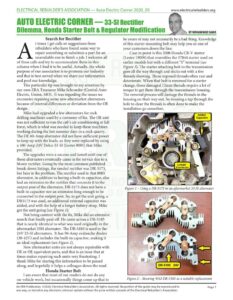
ELECTRICAL REBUILDER’S ASSOCIATION — Auto Electric Corner 2020_05 www.electricalrebuilders.org AUTO ELECTRIC CORNER — 33-Si Rectifier Search for Rectifier t times I get calls or suggestions from rebuilders who have found some way to repair something or substitute a part for an unavailable one to finish a job. I welcome all of these calls and try to accommodate them in this column when I find it to be useful. Actually, the whole purpose of our association is to promote our industry and that is best served when we share our information and pool our knowledge. This particular tip was brought to my attention by our own ERA Treasurer Mike Schroeder (Central Auto Electric, Union, MO). It was regarding the issues we encounter repairing some new aftermarket alternators because of internal differences or deviation from the OE design. Mike had upgraded a few alternators for rock drilling machines used by a customer of his. The OE unit was not sufficient to run the cab’s air-conditioning at full force, which is what was needed to keep these machines working during the hot summer days in a rock quarry. The OE 60-Amp alternator did not have sufficient power to keep up with the loads, so they were replaced by using a 100-Amp 24V Delco 33-SI (Lester 8085) that Mike provided. The upgrades were a success and lasted until one of those alternators eventually came in for service due to a blown rectifier. Going by the most common published break-down listings, the needed rectifier was DR-5173, but here is the problem. The rectifier used in that 8085 alternator, in addition to having a built-in capacitor, also had an extension to the rectifier that connects it to the output post of the alternator. DR-5173 does not have a built-in capacitor nor an extension long enough to be connected to the output post. So, to get the unit going, a DR5173 was used, an additional external capacitor was added, and with the help of a longer battery strap, Mike got the unit going (see Figure 1). Not being content with the fix, Mike did an extensive search that finally paid off. He came across a DR-5185 that is nearly identical to what was used originally in the aftermarket 33S] alternator. The DR-5185 is used in the 24V 23-SI alternators. It has 50-Amp avalanche diodes (38-42V) and includes the built-in capacitor, making it an ideal replacement (see Figure 2). New aftermarket units are not always repairable with OE or OE equivalent parts, and that is an issue that at times makes repairing such units very frustrating. I thank Mike for sharing this information to be passed along, and hopefully it helps a colleague down the road. Honda Starter Bolt I am aware that most of our readers do not do any on-vehicle work, but occasionally things come up that to Dilemma, Honda Starter Bolt & Regulator Modification BY MOHAMMAD SAMII be aware of may not necessarily be a bad thing. Knowledge of this starter mounting bolt may help you or one of your customers down the line. Case in point is this 2008 Honda CR-V starter (Lester 19009) that resembles the 17844 starter used on earlier models but with a different “S” terminal (see Figure 3). The starter attaching bolt to the transmission goes all the way through and sticks out with a few threads showing. Those exposed threads often rust and deteriorate. When that bolt is removed for a starter change, those damaged 12mm threads require a lot of torque to get them through the transmission housing. The removal process will damage the threads in the housing on their way out. So running a tap through the hole to clear the threads is often done to make the installation go smoother. Figure 2 – Showing WAI DR-5185 as a suitable replacement An ERA Publication. ©2020, Electrical Rebuilder’s Association. All rights reserved. No portion of the guide may be reproduced in Page 1 any way, or stored in any electronic retrieval system without the prior written consent of the Electrical Rebuilder’s Association. ELECTRICAL REBUILDER’S ASSOCIATION — Auto Electric Corner 2020_05 www.electricalrebuilders.org AUTO ELECTRIC CORNER AMT Figure 4 – Uncommon thread pitch for Honda starter bolts What makes it interesting is the uncommon thread pitch of those mounting bolts. The 12 mm bolts are usually either Fine Thread (1.50 X 12mm) or Course Thread (1.75 X 12mm). But the bolts used here are extra fine 1.25 X 12mm. A difference that cannot be determined easily by looking at it unless you use a thread gauge. The problem arises when the technician tries to chase the scored threads in the transmission housing with a common fine tread (1.50 X 12mm) tap, and then you can imagine the damages to the housing that now cannot accept an original new bolt (see Figure 4). The right size tap and die has been in my tool box for a long time for an obvious reason, and new bolts are also available at Honda dealers for around five or six dollars each. But by using the wrong size tap on the transmission housing, even a new bolt becomes useless as they would not go in without being cross-threaded, and then the damage to the housing would be catastrophic. Just a little point to remember if you sell one of these to an installer.. Modifying a CS130-D for 19V…! A CS130-D was brought in to be rebuilt and mortified to single wire self-exciting and to charge at 19 Volts…! I understand there are cases that a self-exciting alternator may be a viable or the only option for some old machinery, like tractors, forklifts and assorted equipment. But I am not a big advocate of single wire alternators. On cars and trucks if economically feasible, I prefer to repair the related wiring properly rather than hanging an SE alternator on and letting it go. In the case of this customer, considering he was going to use it on a racing application, I agreed to it, especially when he accepted my price…! So the alternator was rebuilt and then it came time for installing a CS130-D-SE regulator that charges at 19V. To be brief, there are none to be found. Regitar had discontinued their version due to lack of interest and low sales a long time ago and no other supplier has such a regulator, to the best of my knowledge. After a little search, I found that CS130 SE regulators such as WAI’s D411SE190 or Regitar’s D694W-SEL are plentiful and available, so why not try to fit that into a CS130-D alternator…?! Figure 5 – Pin configuration of CS-130 and CS-130D regulators An ERA Publication. ©2020, Electrical Rebuilder’s Association. All rights reserved. No portion of the guide may be reproduced in Page 2 any way, or stored in any electronic retrieval system without the prior written consent of the ElectricalPRebuilder’s Association.