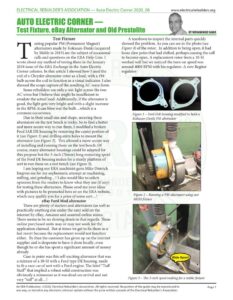
ELECTRICAL REBUILDER’S ASSOCIATION — Auto Electric Corner 2020_08 AUTO ELECTRIC CORNER — Test Fixture esting popular PM (Permanent Magnet) alternators made by Kokusan-Denki (acquired by Mahle in 2015) are the subject of occasional calls and questions on the ERA Help-Line. I wrote about my method of testing these in the January 2018 issue of the ERA Exchange in the Auto Electric Corner column. In that article I showed how I used the coil of a Chrysler alternator rotor as a load, with a 194 bulb across the coil to function as a visual indicator. I also showed the scope capture of the resulting AC wave form. Some rebuilders use only a test-light across the two AC wires but I believe that might be insufficient to emulate the actual load. Additionally, if the alternator is good, the light gets very bright and with a slight increase in the RPM, it can blow out the bulb…which is a common occurrence. Due to their small size and shape, securing these alternators on the test bench is tricky. So to find a better and more secure way to run them, I modified a broken Ford IAR DE housing by removing the center portion of it (see Figure 1) and drilling extra holes to mount the alternator (see Figure 2). This allowed a more secure way of installing and running them on the test bench. Of course, many alternator housings could be adapted for this purpose but the 3-inch (76mm) long mounting spool of the Ford DE housing makes for a sturdy platform of sort to run these on a test bench (see Figure 3). Tam hoping our ERA machinist guru Mike Dietrich forgives me for my sophomoric attempt at machining, milling, and grinding…! I also would like to solicit opinions from the readers to know what they use (if any) for testing these alternators. Please send me your ideas with pictures to be promoted here or on the ERA website, which may qualify you for a prize of some sort…! eBay Ford Mod alternator There are plenty of starters and alternators (as well as practically anything else under the sun) sold on the internet by eBay, Amazon and assorted online stores. There seems to be no slowing down in that regards. These online purchased units may or may not work for the application claimed. But at times we get to fix them as a last resort because the replacement would not function either. By then the customer has given up on the internet supplier and is desperate to have it done locally, even though he or she has spent a significant amount of money already. Case in point was this self-exciting alternator that was a mixture of a 10-SI with a Ford type DE housing, made to fit a race car of sort with a Ford engine. The label “Tuff Stuff that implied a robust solid construction was obviously a misnomer as it was dead-on-arrival and not very “tuff” at all…! Test Fixture, eBay Alternator and Old Prestolite www.electricalrebuilders.org BY MOHAMMAD SAMII A teardown to inspect the internal parts quickly showed the problem. As you can see in the photo (see Figure 4) of the rotor. In addition to being open, it had loose claw poles that had shifted, perhaps causing the coll to become open. A replacement rotor from a 10-SI worked well but we noticed the turn-on speed was around 4000 RPM with his regulator. A new Regitar regulator Figure 2 – Running a PM alternator using our MOD fixture ~~ Figure 3 – The 3-inch spool making for a stable fixture An ERA Publication. ©2020, Electrical Rebuilder’s Association. All rights reserved. No portion of the guide may be reproduced in Page 1 any way, or stored in any electronic retrieval system without the prior written consent of the Electrical Rebuilder’s Association. ELECTRICAL REBUILDER’S ASSOCIATION — Auto Electric Corner 2020_08 www.electricalrebuilders.org AUTO ELECTRIC CORNER was installed which brought the turn-on RPM down toa very acceptable 2000 RPM. As usual, I gave the customer a little lecture, emphasizing the benefits of getting things done locally with the people who live, pay taxes, and support the infrastructure in their own backyard, something that cannot be expected from an unknown eBay seller. An Old Prestolite Alternator When possible and feasible, I try to stick to rebuilding an original alternator that came with the machine rather replacing it with a 10-SI or and any other modified units. My reasoning is twofold: first, rebuilding the original unit, particularly if it is a rare hard-to-find one commands a much better price, and second, with these days of internet accessibility, almost everyone can find a self-exciting alternator, thus my services may not be needed as much. Whatever the reason; I prefer rebuilding the originals. Case in point was this older ALK-6221 Prestolite alternator (see Figure 5) from an old Eaton (Yale) forklift that could not be found anywhere. The customer who depended on his machine was desperate as his effort to find one at various auto part stores did not pan out, and he was directed by one of them to us. Sammy’s Auto Electric Service, Inc. Figure 5 – Prestolite ALK-6221 for an old Eaton (Yale) forklift Rebuilding the alternator was a straightforward process as far as rebuilding an old Prestolite alternator was concerned. The teardown went as planned without breaking anything, the stator, regardless of its age, was in a very good shape, the slip-ring was good enough to be polished, and the regulator checked fine. The blown diodes were easily replaced and after cleanup and blasting, it turned out to be a satisfactory rebuilt, delivered in a clean and service-ready shape to a happy customer who did not think twice about our $275.00 invoice. While rebuilding this alternator and changing the blown rectifier diodes, I noticed this was one of those old style units that has 4 diodes on the positive heatsink. Three diodes are the typical positive diodes that are attached to any positive rectifier heatsink but the fourth diode that acts as an isolation diode is Negative, even if it is pressed into the positive heatsink. A point that must be observed, otherwise the alternator would not work. Since this single diode carries the entire alternator’s output, it is preferable to use one with 35 or 50-Amp capability (see Figure 6). It should also be noted that there is a post on this alternator that the battery positive connects to. It is totally insulated and does not have any connection to anything inside the alternator. The isolation diode is connected to the output post which is connected externally through a short fusible link called a Reverse Polarity Protection or RPP link to the battery post. The RPP is there to protect the alternator from a reverse polarity connection, such as hooking up the battery backward (see Figure 7). In our case the RPP link was missing, probably discarded during the long years of service. So we instructed the customer to use the output post for the B+ wire. For more details on this alternator you can check out “Look-Up Diagrams” heading of the Jimco on-line catalog on the ERA website, select Prestolite and click on PRES24 on the bottom row of the first page for all of the details. Sammy’s Auto Electric Service, Inc. Figure 6 – Positive heatsink of the Prestolite ALK alternator An ERA Publication. ©2020, Electrical Rebuilder’s Association. All rights reserved. No portion of the guide may be reproduced in Page 2 any way, or stored in any electronic retrieval system without the prior written consent of the ElectricalPRebuilder’s Association.