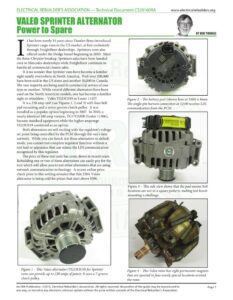
ELECTRICAL REBUILDER’S ASSOCIATION — Technical Document CS201609A www.electricalrebuilders.org VALEO SPRINTER ALTERNATOR Power to Spare t has been nearly 15 years since Damler-Benz introduced Sprinter cargo vans to the US market, at first exclusively through Freightliner dealerships. Sprinters were also offered under the Dodge brand beginning in 2003. Since the Benz-Chrysler breakup, Sprinters sales have been handed over to Mercedes dealerships while Freightliner continues to handle all commercial chassis sales. It is no wonder that Sprinter vans have become a familiar sight nearly everywhere in North America. Well over 200,000 have been sold in the US alone and another 30,000 in Canada. The vast majority are being used in commercial service of one type or another. While several different alternators have been used on the North American models, one has become a familiar cn ____ BY BOB THOMAS It is a 220 amp unit (see Figures 1, 2 and 3) with four bolt The single-pin harness connection at 12:00 receives LIN pad mounting and a seven-groove clutch pulley. It was communication from the PCM. installed as a popular option beginning in 2007. In 2010, a nearly identical 180 amp version, TG17C030B (Lester 11306), became standard equipment while the higher amperage TG23C019 continued as an option. Both alternators are self exciting with the regulator’s voltage set point being controlled by the PCM through the van’s data network. While you can bench test these alternators in default mode, you cannot test complete regulator function without a test lead or apparatus that can mimic the LIN communication recognized by this regulator. The price of these test tools has come down in recent years. Rebuilding one or two of these alternators can easily pay for the tool which will allow you to test other alternators that are using network communication technology. A recent online price check prior to this writing revealed that this 220A Valeo alternator is being sold for prices that start above $500. Figure 3 – This side view shows that the pad-mount bolt locations are not in a square pattern, making test bench mounting a challenge. Figure 1 – This Valeo alternator (TG23C019) for Sprinter vans can provide up to 220 amps of power. It uses a 7-groove Figure 4 – This Valeo rotor has eight permanent magnets that are epoxied in four evenly spaced locations around clutch pulley. the rotor. An ERA Publication. ©2015, Electrical Rebuilder’s Association. All rights reserved. No portion of the guide may be reproduced in Page 1 any way, or stored in any electronic retrieval system without the prior written consent of the Electrical Rebuilder’s Association. www.electricalrebuilders.org Both alternators present rebuilding opportunities. As you would expect, the clutch pulleys are the fastest wearing part on vehicles used primarily in the cities and often the first to fail. The bearings are both common sizes – 6202 on the slip ring end and 6303 on the drive end. Brushes, voltage regulator and other parts are all available at reasonable prices. There are a few things that you must be aware of when rebuilding this alternator, starting with the rotor (see Figures 4 and 5). As you can in the photos, there are four sets of permanent magnets glued on each side of every other drive end . 1 pole claw. It is most important to mark the slip ring leads when E Bositive + B-Circuit Field changing them so as to not oppose the polarity of the permanent magnets. It is also prudent to test this rotor in the same polarity it will normally operate at (see Figure 6). While these magnets will contribute some magnetism during charging, that is not their main purpose. They are there primarily to assure self excitation. This alternator’s regulator voltage set point is controlled by LIN communication. But the regulator cannot be turned on by that communication. It is purely self-exciting. In the absence of a LIN communication, it will charge at a default rate of approximately 14.2 volts. Ifa LIN communication is present on the vehicle or when bench testing, the voltage set point will vary from 12.6 to 16.0 volts, depending upon the LIN command, loads, battery condition and state of charge. This regulator has a single terminal (see Figure 7). As you can see in the photo, pin 1 is LIN and pin 2 is missing altogether – so there is “no connection”. This is plug code 063, one of six covered by Scott Scharrer’s plug Code article in this issue. Adjusting the regulator’s voltage set point is relatively simple when you have the proper tool to do it (see Figures 8, 9 and 10). As you can see in the photos, charging voltage may be tested at several levels to verify that the alternator will perform properly with the PCM’s LIN communication once installed on a vehicle. Negative – Ground Brush | divin ee | tos gmee patietee a Figure 6 – This rotor’s polarity must be observed. Reversing polarity works against the magnets. When replacing slip rings, mark coil leads to ensure that polarity is not reversed. (Tim Figure 7 – This regulator uses a fairly common two pin Bosch connector, but notice that it only has one pin – used for LIN communication. Space 2 in the plug is blank or “no connection.” Figure 8 – Here the alternator has self excited and is charging at the default rate. The LIN signal is turned off on the test box. Note the adjustable mounting bracket that was helpful to keep the belt straight. Figure 5 – Here you can see that each magnet abuts one side of a drive end pole claw, creating sufficient magnetic force to guarantee self excition at idle engine speed. An ERA Publication. ©2015, Electrical Rebuilder’s Association. All rights reserved. No portion of the guide may be reproduced in Page 2 any way, or stored in any electronic retrieval system without the prior written consent of the Electrical Rebuilder’s Association.