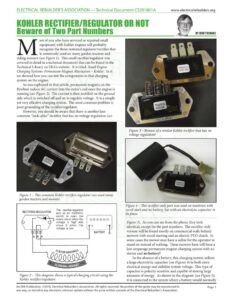
www.electricalrebuilders.org ost of you who have serviced or repaired small equipment with Kohler engines will probably recognize the three-terminal regulator/rectifier that is commonly used on many garden tractors and riding mowers (see Figure 1). This small rectifier/regulator was covered in detail in a technical document that can be found in the Technical Library on ERA’s website. It is titled: Small Engine Charging Systems: Permanent-Magnet Alternators – Kohler. In it we showed how you can test the components in that charging system on the engine. As was explained in that article, permanent magnets on the flywheel induce AC current into the stator’s coil once the engine is running (see Figure 2). The current is then rectified on the ground side which is switched off and on to regulate voltage. It is a simple yet very effective charging system. The most common problem is poor grounding of the rectifier/regulator. However, you should be aware that there is another less- common “look-alike” rectifier that has no voltage regulation (see Figure 1 – This common Kohler rectifier-regulator was used many garden tractors and mowers. The rectifier-reguiator acts as an electronic switch to open the return circuit when the voltage is high and close it when the voltage is low. RECTIFIER-REGULATOR Figure 2 – This diagram shows a typical charging circuit using the Kohler rectifier/regulator. BY BOB THOMAS Figure 3 – Beware of a similar Kohler rectifier that has no voltage regulation! Figure 4 – This rectifier-only part was used on machines with recoil start and no battery, but with an electrolytic capacitor in its place. Figure 3). As you can see from the photo, they look identical, except for the part numbers. The rectifier-only version will be found mostly on commercial walk-behind mowers with recoil starting and an electric PTO clutch. In some cases the mower may have a sulkie for the operator to stand on instead of walking. These mowers have will have a low-amperage permanent-magnet charging system with no starter and no battery! In the absence of a battery, this charging system utilizes a large electrolytic capacitor (see Figures 4) to both store electrical energy and stabilize system voltage. This type of capacitor is polarity sensitive and capable of storing large amounts of energy. As shown in the diagram (see Figure 5), it is connected to the system where a battery would normally An ERA Publication. ©2018, Electrical Rebuilder’s Association. All rights reserved. No portion of the guide may be reproduced in Page 1 any way, or stored in any electronic retrieval system without the prior written consent of the Electrical Rebuilder’s Association. ELECTRICAL REBUILDER’S ASSOCIATION — Technical Document CS201801A www.electricalrebuilders.org KOHLER RECTIFIER/REGULATOR OR NOT ELECTROLYTIC RECTIFIER ONLY CAPACITOR STATOR WINDING? Figure 5 – This diagram shows the charging circuit using the rectifier without voltage regulation. be found. After starting, alternator output charges the capacitor through the rectifier, which provides some of the inrush current needed to engage the PTO clutch when it is switched on. Without regulation, system voltage will run higher than you would expect until the PTO is activated. Figure 6 – Here we are bench testing a Kohler rectifier/ These parts cannot be interchanged. Should a customer regulator using AC voltage directly off the stator of a 10SI bring you a Kohler rectifier/regulator, looking for a replacement, alternator. do not assume it is the one that you are most familiar with. Ask the question. Does it have electric or recoil starting? If it is recoil start, check the part numbers below. Electronic Regulator/Rectifier, 12v, 14.4v set point Used with Kohler 10 to 15A permanent-magnet alternators on engine models KT17 through KT19 & M8 through MV20. John Deere AM106357, AM34738 Kohler 2575503, 25755038, 4140305, 4140306, 4140309 Tecumseh 610479 Transpo KH4309 J&N_ 230-22032 Electronic Rectifier, 12v (no voltage regulation) Used with Kohler engines on commercial mowers with recoil start and electric PTO clutch John Deere M131287 Kohler 1240301 Transpo KH4301 J&N 230-22037 Testing either of these parts is fairly simple, using two phase connections on any alternator that you can full field on your test bench. In the photo (see Figure 6), I am using a 10S] alternator that I’ve made all connections external. I have full-fielded the rotor to simulate permanent magnets (field polarity is inconse- quential) and I have connected the Kohler rectifier to two of the 10SI’s stator leads. Then I connected the rectifier-regulator itself to the test bench battery. If you perform this test, be sure that you do not exceed the normal 10 amp output of the Kohler system. You can do that by controlling the alternator’s speed. It can exceed 10 amps very quickly if you run it too fast. The regulated rectifier should keep voltage close to 14 volts while the unregulated rectifier will quickly exceed 15 volts with no limit other than battery capacitance. An ERA Publication. ©2018, Electrical Rebuilder’s Association. All rights reserved. No portion of the guide may be reproduced in Page 2 any way, or stored in any electronic retrieval system without the prior written consent of the Electrical Rebuilder’s Association.