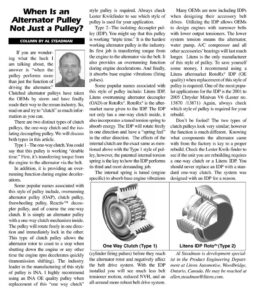
When Is an Alternator Pulley Not Just a Pulley? COLUMN BY AL STEADMAN If you are wonder- ing what the heck I am talking about, the answer is “when the pulley performs more than just the function of driving the alternator.” Clutched alternator pulleys have taken the OEMs by storm and have finally made their way to the reman industry. So, read on and try to “clutch” as much infor- mation as you can. There are two distinct types of clutch pulleys, the one-way clutch and the iso- lating decoupling pulley. We will discuss both types in this article. Type 1—The one-way clutch. You could say that this pulley is working “double time.” First, it’s transferring torque from the engine to the alternator via the belt. In addition, it is providing an over- running function during engine deceler- ations. Some popular names associated with this style of pulley include, overrunning alternator pulley (OAP), clutch pulley, freewheeling pulley, Reactiv™ decou- pler pulley, and of course the one-way clutch. It is simply an alternator pulley with a one-way clutch mechanism inside. The pulley will rotate freely in one direc- tion and immediately lock in the other. This type of clutch pulley allows the alternator rotor to coast to a stop when shutting down the engine or any other time the engine rpm decelerates quickly (transmission shifting). The industry leader in the manufacturing of this style of pulley is INA. I highly recommend using an INA OE quality pulley when replacement of this “one way clutch” style pulley is required. Always check Lester Kwikfinder to see which style of pulley is used for your application. Type 2—The isolating decoupler pul- ley (DP). You might say that this pulley is working “triple time.” It is the hardest working alternator pulley in the industry. Its first job is transferring torque from the engine to the alternator via the belt. It also provides an overrunning function during engine decelerations. And finally, it absorbs base engine vibrations (firing pulses). Some popular names associated with this style of pulley include: Litens IDP, Litens overrunning alternator decoupler (OAD) or RotoRx®. RotoRx® is the after- market name given to the IDP. The IDP not only has a one-way clutch inside, it also incorporates a tuned torsion spring to absorb energy. The IDP will rotate freely in one direction and have a “spring feel” in the other direction. The effects of the internal clutch are the exact same as men- tioned above with the Type 1 style of pul- ley, however, the patented internal torsion spring is the key to how the IDP performs its third and most demanding job. The internal spring is tuned (engine specific) to absorb base engine vibrations One Way Clutch (Type 1) (cylinder firing pulses) before they reach the alternator rotor and negatively affect the belt drive system. With the IDP installed you will see much less belt tensioner motion, reduced NVH, and an all-around more robust belt drive system. Many OEMs are now including IDPs when designing their accessory belt drives. Utilizing the IDP allows OEMs to design engines with narrower belts with lower output tensioners. The lower system tension means the alternator, water pump, A/C compressor and all other accessories’ bearings will last much longer. Litens is the only manufacturer of this style of pulley. To save yourself some money, I recommend using a Litens aftermarket RotoRx® IDP (OE quality) when replacement of this style of pulley is required. One of the most popu- lar applications for the IDP is the 2001 to 2005 Chrysler Minivan V6 (Lester no. 13870 /13871) Again, always check which style of pulley is required for your rebuild. Don’t be fooled! The two types of clutch pulleys look very similar; however the function is much different. Knowing what components the alternator came with from the factory is key to a proper rebuild. Check the Lester Kwik-finder to see if the unit you are rebuilding requires a one-way clutch or a Litens IDP. You should never replace an IDP with a stan- dard one-way clutch. The system was designed with an IDP for a reason. Litens IDP Roto™ (Type 2) Al Steadman is development special- ist in the Product Engineering Depart- ment at Litens Automotive, Woodbridge, Ontario, Canada. He may be reached at allen.steadman@litens.com.