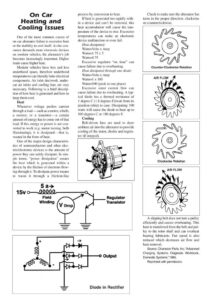
On Car Heating and Cooling Issues One of the most common causes of on-car alternator failure is excessive heat or the inability to cool itself. As the con- sumer demands more electronic devices on modern vehicles, the alternator’s job becomes increasingly important. Higher loads cause higher heat. Modern vehicles have less and less underhood space, therefore underhood temperatures can literally bake electrical components. Air inlet ductwork, under- car air inlets and cooling fans are very necessary. Following is a brief descrip- tion of how heat is generated and how to keep them cool. Heat Whenever voltage pushes current through a load—such as a motor, a bulb, a resistor, or a transistor—a certain amount of energy has to come out of that load. If this energy or power is not con- verted to work (e.g. motor turning, bulb illuminating), it is dissipated—that is, wasted in the form of heat. One of the major design characteris- tics of semiconductors and other elec- tric/electronic devices is the amount of power they can safely dissipate. In sim- ple terms, “power dissipation’ means the heat which is generated within a device by the friction of electrons flow- ing through it. To dissipate power means to waste it through a friction-like process by conversion to heat. If heat is generated too rapidly with- in a device and can’t be removed, this heat accumulation will cause the tem- perature of the device to rise. Excessive temperatures can make an electronic device malfunction or even fail. Heat dissipated: Watts=Volts x Amp Watts=1.75 x 5 Watts=8.75 Excessive regulator “on time” can cause failure due to overheating. Heat dissipated through one diode: Watts=Volts x Amp Watts=1 x 100 Watts=100 (peak in one phase) Excessive stator current flow can cause failure due to overheating. A typ- ical diode has a thermal resistance of 1 degree C (1.8 degrees F)/watt from its junction (chip) to case. Dissipating 100 watts will cause the diode to heat up to 100 degrees C or 180 degrees F. Cooling Belt-driven fans are used to draw ambient air into the alternator to provide cooling of the stator, diodes and regula- tor (if integral). Check to make sure the alternator fan turns in the proper direction: clockwise or counterclockwise. 7 ©)Z Clockwise Rotation 59 a> 15v Field Winding Regulator Transistor Diode in Rectifier AIR FLOW A slipping belt does not turn a pulley efficiently and causes overheating. This heat is transferred from the belt and pul- ley to the rotor shaft and can overheat bearing lubricants. Fan speed is also reduced which decreases air flow and heat removal. Source: Champion Parts, Inc. “Advanced Charging Systems Diagnosis Workbook, Domestic Systems,” 1995. Reprinted with permission.