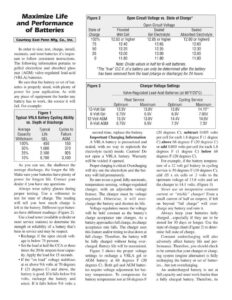
Maximize Life and Performance of Batteries Courtesy East Penn Mfg. Co., Inc. In order to size, test, charge, install, maintain, and store batteries it’s impor- tant to follow consistent instructions. The following information pertains to gelled electrolyte and absorbed glass mat (AGM) valve-regulated lead-acid (VRLA) batteries. Be sure that the battery or set of bat- teries is properly sized, with plenty of power for your application. As with any piece of equipment the harder any battery has to work, the sooner it will fail. For example: Figure 1 Typical VRLA Battery Cycling Ability vs. Depth of Discharge Average Typical Cycles to Capacity Life Failure Withdrawn GEL AGM 100% 450 150 50% 1,000 370 25% 2,100 925 10% 5,700 3,100 As you can see, the shallower the average discharge, the longer the life. Make sure your batteries have plenty of power for longest life. Contact your dealer if you have any questions. Always wear safety glasses during proper testing. Use a voltmeter to test for state of charge. The reading will tell you how much charge is left in the battery. Different type batter- ies have different readings: (Figure 2). Use a load tester (available at dealer or most service stations) to determine the strength or reliability of a battery that’s been in service and may be suspect. * Recharge if the open circuit volt- age is below 75 percent. ¢ Set the load at half the CCA or three times the 20-hr ampere-hour capac- ity. Apply the load for 15 seconds. e If the “on load” voltage stabilizes at or above 9.6 volts at 70 degrees F (21 degrees C) and above, the battery is good. If it falls below 9.6 volts, recharge the battery and retest. If it falls below 9.6 volts a Figure 2 Open Circuit Voltage vs. State of Charge* Open Circuit Voltage State of Flooded Sealed Sealed Charge Wet Cell Gel Electrolyte Absorbed Electrolyte 100% 12.60 or higher 12.85 or higher 12.80 or higherd 75 12.40 12.65 12.60 50 12.20 12.35 12.30 25 12.00 12.00 12.00 0 11.80 11.80 11.80 Note: Divide values in half for 6-volt batteries. *The “true” 0.C.V. of a battery can only be determined after the battery has been removed from the load (charge or discharge) for 24 hours. Figure 3 Charger Voltage Settings Valve-Regulated Lead-Acid Batteries (at 68°F/20°C) Float Service Cycling Service Optimum Maximum Optimum Maximum 12-Volt Gel 13.5V 13.8V 13.8V 14.1V* 6-Volt Gel 6.75V 6.9V 6.9V 7.05V 12-Volt AGM 13.5V 13.8V 14.4V 14.6V 6-Volt AGM 6.75V 6.9V 7.2V 7.3V second time, replace the battery. Important Charging Information A VRLA battery is pressurized and sealed, with no way to replenish the electrolyte (acid) inside. Caution! Do not open a VRLA battery. Warranty will be voided if opened. Proper charging is critical. Overcharging will dry out the electrolyte and the bat- tery will fail prematurely. Be sure to use a good, fully-automatic, temperature-sensing, voltage-regulated charger, with an adjustable voltage feature. The charger must be voltage regulated. Otherwise, it will over- charge the battery and shorten its life. Voltage regulation means the voltage will be held constant as the battery’s charge acceptance rate changes. As a battery approaches full charge, its charge acceptance rate falls. The charger uses this feature and/or timing to shut down at full charge. Therefore, the battery will be fully charged without being over- charged. Battery life will be maximized. Figure 3 shows the proper voltage settings to recharge a VRLA gel or AGM battery at 68 degrees F (20 degrees C). Both gel and AGM batter- ies require voltage adjustment for bat- tery temperature. To compensate for battery temperature not at 68 degrees F (20 degrees C), subtract 0.005 volts per cell for each 1.8 degree F (1 degree C) above 68 degrees F (20 degrees C) or add 0.005 volts per cell for each 1.8 degrees F (1 degree C) below 68 degrees F (20 degrees C). For example, if the battery tempera- ture of a 12 volt gel battery in cycling service is 50 degrees F (10 degrees C), add .05 x six cells or .3 volts to the optimum voltage of 13.8 volts and set the charger to 14.1 volts. (Figure 3) Never use an inexpensive constant current or “trickle” charger! Even a small current of half an ampere, if left on beyond “full charge” will over- charge any battery and ruin it. Always keep your batteries fully charged…especially if they are to be stored for 30 days or longer. Use the state of charge chart (Figure 2) to deter- mine full state of charge. Constant undercharging will also adversely affect battery life and per- formance. Therefore, you should check to be certain that your charger or charg- ing system (engine alternator) is fully recharging the battery or set of batter- ies…but not overcharging. An undercharged battery is not at full capacity and must work harder than a fully charged battery. Therefore, its