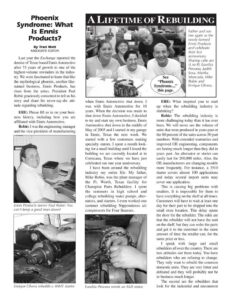
Phoenix Syndrome: What Is Ennis Products? By Traci Matt ASSOCIATE EDITOR Last year the Exchange reported the demise of Texas-based Ennis Automotive after 73 years of growth to one of the highest-volume rewinders in the indus- try. We were fascinated to learn that like the mythological phoenix, another like- named business, Ennis Products, has risen from the ashes. President Paul Robie graciously consented to tell us his story and share his never-say-die atti- tude regarding rebuilding. ERE: Please fill us in on your busi- ness history, including how you are affiliated with Ennis Automotive. Robie: I was the engineering manager and the vice president of manufacturing ” = MN Ennis Products owner Paul Robie: You can’t keep a good man down! Enrique Olvera rebuilds a 40MT starter. A LIFETIME © OF REBUILDING when Ennis Automotive shut down. I was with Ennis Automotive for 10 years. When the decision was made to shut down Ennis Automotive, I decided to try and start my own business. Ennis Automotive shut down in the middle of May of 2005 and I started in my garage in Ennis, Texas the next week. We started with a few customers making specialty stators. I spent a month look- ing for a small building until I found the building we are currently located at in Corsicana, Texas where we have just celebrated our one year anniversary. I have been around the rebuilding industry my entire life. My father, Mike Robie, was the plant manager of the Ft. Worth, Texas facility for Champion Parts Rebuilders. I spent the summers in high school and college rebuilding water pumps, alter- nators, and starters. I even worked one summer rebuilding Nippondenso a/c compressors for Four Seasons. Eusebia Pinzana winds an R&R stator. Syndrome…” Father and son rise again as the newly formed Ennis Products and celebrate their first anniversary. Sharing cake are (L to R) Eusebia Pinzana, Judith Sosa, Martha Moncada, Mike Robie and Enrique Olvera. “Phoenix this page. ERE: What inspired you to start up when the rebuilding industry is shrinking? Robie: The rebuilding industry is more challenging today than it has ever been. We will never see the volume of units that were produced in years past or the 80 percent of the sales across 50 part numbers. With extended warranties and improved OE engineering, components are lasting much longer than they did in years past. An alternator or starter can easily last for 200,000 miles. Also, the OE manufacturers are changing models more frequently. For instance, a 3510 starter covers almost 100 applications and today several import units may cover one application. This is causing big problems with retailers. It is impossible for them to have everything on the shelf at all times. Customers will have to wait at least one day for their part to be shipped into the retail store location. This delay opens the door for the rebuilder. The odds are that the rebuilder will not have the unit on the shelf, but they can order the parts and get it to the customer in the same amount of time the retailer can, for the same price or less. I speak with large and small rebuilders all over the country. There are two attitudes out there today. You have rebuilders who are refusing to change. They only want to rebuild the common domestic units. They are very bitter and defeated and they will probably not be in business much longer. The second are the rebuilders that look for the industrial and uncommon