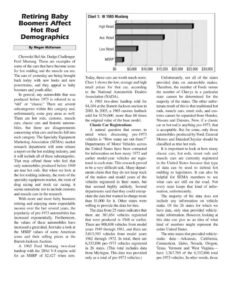
Retiring Baby Boomers Affect Hot Rod Demographics By Megan McKernan Chevrolet Bel Air. Dodge Challenger. Ford Mustang. Those are examples of some of the cars that have become icons for hot rodding and the muscle car era. The cars of yesterday are being brought back today with new looks and new powertrains, and they appeal to baby boomers and youth alike. In general, any automobile that was produced before 1973 is referred to as “old” or “classic.” There are several subcategories within this category and, unfortunately, some grey areas as well. There are hot rods, customs, muscle cars, classic cars and historic automo- biles, but there are disagreements concerning what cars and trucks fall into each category. The Specialty Equipment Marketing Association (SEMA) market research department will soon release a report on the hot rodding industry, and it will include all of these subcategories. That may offend those who feel that only automobiles produced before 1949 are true hot rods. But when we look at the hot rodding industry, the roots of the specialty-equipment market, the roots of drag racing and stock car racing, it seems unrealistic not to include customs and muscle cars in the research. With more and more baby boomers retiring and enjoying more expendable income over the last several years, the popularity of pre-1973 automobiles has increased exponentially. Furthermore, the values of these automobiles have increased a great deal. Just take a look at the MSRP values of some American icons and their selling prices at the Barrett-Jackson Auction. A 1965 Ford Mustang two-door hardtop with the 289ci V-8 engine sold for an MSRP of $2,427 when new. Chart 1: 8 1965 Mustang High Retail Ave. Retail Low Retail MSRP $0 $5,000 $10,000 $15,000 $20,000 $25,000 $30,000 Today, those cars are worth much more. Chart 1 shows the low, average and high retail prices for that car, according to the National Automobile Dealers Association (NADA). A 1965 two-door hardtop sold for $4,104 at the Barrett-Jackson auction in 2003. In 2005, a 1965 custom fastback sold for $156,600, more than 60 times the original value of the base model. Classic Car Registrations A natural question that comes to mind when discussing pre-1973 vehicles is “How many are out there?” Departments of Motor Vehicles across the United States have been contacted for information on how many 1972 and earlier model-year vehicles are regis- tered in each state. This research proved to be a very difficult task. Many depart- ments claim that they do not keep track of the makes and model years of the vehicles registered in their states, but that seemed highly unlikely. Several departments said that they could extrap- olate the data but wanted to charge more than $1,000 for it. Other states were willing to provide the data for free. The data from 25 states indicates that there are 381,654 vehicles registered that were produced in 1948 or earlier. There are 908,608 vehicles from model years 1949 through 1961, and there are 5,013,393 vehicles from model years 1962 through 1972. In total, there are 6,332,896 pre-1973 vehicles registered in 26 states. (This total includes data from Michigan. This data was provided only as a total of pre-1973 vehicles.) Unfortunately, not all of the states provided data on automobile makes. Therefore, the number of Fords versus the number of Chevys in a particular state cannot be determined for the majority of the states. The other unfor- tunate result of this is that traditional hot rods, muscle cars, street rods, and cus- toms cannot be separated from Hondas, Nissans and Datsuns. Now, if a classic car or hot rod is anything pre-1973, that is acceptable. But for some, only those automobiles produced by Ford, General Motors and DaimlerChrysler should be classified as true hot rods. It is important to look at how many classic cars, hot rods, street rods and muscle cars are currently registered in the United States because that type of data can be used to defend hot rodding to legislators. It can also be helpful for SEMA members to see what cars are still on the road. Not every state keeps that kind of infor- mation, unfortunately. The majority of the data does not include any information on vehicle make. Of the 26 states for which we have data, only nine provided vehicle- make information. However, looking at this data can give us an idea of what kind of numbers might represent the entire United States. The nine states that provided vehicle- make data—Arkansas, California, Connecticut, Idaho, Nevada, Oregon, Texas, Vermont and West Virginia have 3,267,769 of the 6,332,896 total pre-1973 vehicles. In other words, those