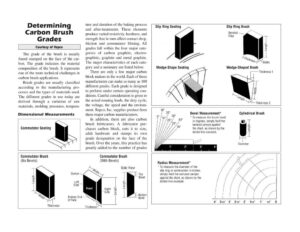
Determining Carbon Brush Grades Courtesy of Repco The grade of the brush is usually found stamped on the face of the car- bon. The grade indicates the material composition of the brush. It represents one of the more technical challenges in carbon brush applications. Brush grades are usually classified according to the manufacturing pro- cesses and the types of materials used. The different grades in use today are derived through a variation of raw materials, molding pressures, tempera- Dimensional Measurements Commutator Seating ture and duration of the baking process and after-treatments. These elements produce varied resistivity, hardness, and strength that in turn affect contact drop, friction and commutator filming. All grades fall within the four major cate- gories of carbon graphite, electro- graphitic, graphite and metal graphite. The major characteristics of each cate- gory and a summary are listed below. There are only a few major carbon block makers in the world. Each of these manufacturers can make as many as 100 different grades. Each grade is designed to perform under certain operating con- ditions. Careful consideration is given to the actual running loads, the duty cycle, the voltage, the speed and the environ- ment. Repco, Inc. supplies product from these major carbon manufacturers. In addition, there are also carbon brush fabricators. A fabricator pur- chases carbon block, cuts it to size, adds hardware and stamps its own grade designation on the face of the brush. Over the years, this practice has greatly added to the number of grades Slip Ring Seating Jue Wedge-Shape Seating Slip Ring Brush Beveled —_ Edge Length hry + Tor Ness] width Wedge-Shaped Brush Thickness 1 Bevel Measurement* * To measure the brush bevel in degrees, simply hold the beveled sample against the chart, as shown by the dotted-line example. Cylindrical Brush Length Diameter Commutator Brush (No Bevels) Corner ~ = mo fom S Left Side “Wy, Bottom End YT of Face Thickness Commutator Brush (With Bevels) A Side View Voy, yy f Top — Bevel = mo 5 Right & “Side § a — L- Bottom Bevel Thickness 7 Radius Measurement* * To measure the diameter of the slip ring or commutator in inches, simply hold the radiused sample against the chart, as shown by the dotted-line example. 4’ 312″ 3” 212″ 2″ 112″ 1″