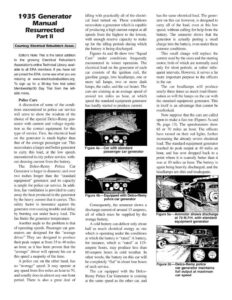
1935 Generator Manual Resurrected Part Il Courtesy Electrical Rebuilders Assoc. Editors Note: This is the latest addition to the growing Electrical Rebuilder’s Association’s online Technical Library, avail- able to all ERA members. If you have not yet joined the ERA, come see what you are missing at www.electricalrebuilders.org. To sign up for a 30-day free trial select Membership/30 Day Trial from the left- side menu. Police Cars A discussion of some of the condi- tions encountered in police car service will serve to show the wisdom of the choice of the special Delco-Remy gen- erator with current and voltage regula- tion as the correct equipment for this type of service. First, the electrical load on the generator is much higher than that of the average passenger car. This necessitates a larger and better generator to carry this load, at the low speeds encountered in city police service, with- out drawing current from the battery. The Delco-Remy Police Car Generator is larger in diameter, and over two inches longer than the “standard equipment” generator, and its capacity is ample for police car service. In addi- tion, fan ventilation is provided to carry away the heat produced in the generator by the heavy current that it carries. This safety factor is insurance against the generator ever causing trouble and delay by burning out under heavy load. The fan limits the generator temperature. Another angle to the problem is that of operating speeds. Passenger car gen- erators are designed for the “average driver.’ They are designed to produce their peak output at from 35 to 40 miles an hour, as it has been proven that the “average” driver will operate his car at this speed a majority of the time. A police car, on the other hand, has no “average” speed. It may operate at any speed from five miles an hour to 70, and usually does in almost any one-hour period. There is also a great deal of idling with practically all of the electri- cal load turned on. These conditions necessitate a generator which is capable of producing a high current output at all speeds from the highest to the lowest, with enough reserve capacity to make up for the idling periods during which the battery is being discharged. Figures 4a and 4b show two “Squad Cars” under conditions frequently encountered in winter operation. The electrical load on the generator of each car consists of the ignition coil, the gasoline gauge, two headlamps, one or more tail lamps, two or more dash lamps, the radio, and the car heater. The cars are cruising at an average speed of around ten miles an hour, at which speed the standard equipment generator has hardly started to produce current. 24 Figure 4a—Car with standard passenger car generator Figure 46—Equipped with Delco-Remy police car generator Consequently, the ammeter shows a discharge current of around 15 amperes, all of which must be supplied by the storage battery. A cold battery can deliver only about half as much electrical energy as one which is operating under the conditions at which the battery is “rated.” A battery, for instance, which is “rated” at 125- ampere hours, may produce less than 60-ampere hours in cold weather. In other words, the battery on this car will be completely “flat” in about four hours of such service. The car equipped with the Delco- Remy Police Car Generator is cruising at the same speed as the other car, and has the same electrical load. The gener- ator on this car however, is designed to carry all of the load, even at this low speed, without calling for help from the battery. The ammeter shows that the generator is actually putting a small charge into the battery, even under these extreme conditions. This small charge will replace the current used by the siren and the starting motor, both of which are normally used only for short periods, at rather infre- quent intervals. However, it serves a far more important purpose to the officers in the car. The car headlamps will produce nearly three times as much road illumi- nation as will the lamps on the car with the standard equipment generator. This in itself is an advantage that cannot be overlooked. Now suppose that the cars are called upon to make a fast run (Figures 5a and 5b, page 13). The speedometers show 65 or 70 miles an hour. The officers have turned on their red lights, further increasing the already severe electrical load. The standard equipment generator reached its peak output at 40 miles an hour, and has now dropped back to a point where it is scarcely better than it was at 10 miles an hour. The battery is again being heavily discharged, and the headlamps are dim and inadequate. Figure 5a—Ammeter shows discharge at 70 M.P.H. with standard equipment generator car generator maintains full output at maximum car speed