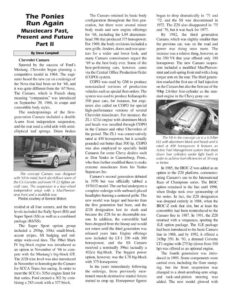
The Ponies Run Again Musclecars Past, Present and Future Part Il By Steve Campbell Chevrolet Camaro Spurred by the success of Ford’s Mustang, Chevrolet began planning a competitive model in 1964. The engi- neers based the new car on a redesign of the Nova that had been set for ‘68, and it was quite different from the “67 Nova. The Camaro, which is French slang meaning “companion,” was introduced on September 29, 1966, in coupe and convertible body styles. The underpinnings of the first- generation Camaro included a double A-arm front independent suspension, and the rear used a solid axle with semi- elliptical leaf springs. Drum brakes The concept Camaro was designed with “69 in mind, but it also follows some of the C6 Corvette and even YF-22 fighter air- craft cues. The suspension is a four-wheel independent setup with a MacPherson- strut front and a multilink rear. Photos courtesy of General Motors resided at all four corners, and the trim levels included the Rally Sport (RS) and Super Sport (SS) as well as a combined package (RS/SS). The Super Sport option group included a 295hp, 350ci small-block, accent stripes, SS badging and red- stripe wide-oval tires. The 396ci Mark IV big-block engine was introduced as an option in November of “66 to com- pete with the Mustang’s big-block GT. The Z/28 trim level was also introduced in November to homologate the Camaro for SCCA Trans Am racing. In order to meet the SCCA’s 305ci engine limit for that series, Ford created a 302 by com- bining a 283 crank with a 327 block. The Camaro retained its basic body configuration throughout the first gen- eration, but there were several minor body mods and new engine offerings for ‘68, including the L89 aluminum- head 396 that produced 375 horsepower. For 1969, the body revisions included a new grille, fenders, doors and rear quar- ters for a wider and lower look, and many Camaro connoisseurs regard the “69 as the best body ever. Some of the best-performing cars, however, came via the Central Office Production Order (COPO) system. COPO was used by GM to produce nonstandard versions of production vehicles such as special fleet orders. The system was used to produce Indianapolis 500 pace cars, for instance, but engi- neers also called on COPO for special high-performance versions of several Chevrolet musclecars. For instance, the ZL1 427ci engine with aluminum block and heads was installed through COPO in the Camaro and other Chevrolets of the period. The ZL1 was conservatively rated at 430 horsepower, but it actually pounded out better than 500 hp. COPO was also employed to specially build Camaros for some Chevy dealers such as Don Yenko in Canonsburg, Penn., who then further modified them to make extreme musclecars from his Yenko Supercars Inc. Camaro’s second generation debuted in 1970 but was officially tabbed a 19701/2 model. The car had undergone a complete redesign with outboard-placed headlights framing a centered grille. The new model was larger and heavier than the first generation had been, and the Z/28 designation lost its slash and became the Z28 for no discernable rea- son. In addition, the convertible had been dropped from the lineup and would not return until the third generation was released years later. Engine offerings now included the LT-1 350 with 360 horsepower, and the SS Camaro received a nominally 396ci (actually a 402ci) big-block. The biggest power option, however, was the L78 big-block with 375 horsepower. In the years immediately following the redesign, those previously men- tioned muscle-destructive market forces started to crop up. Horsepower figures began to drop dramatically in ‘71 and ‘72, and the SS was discontinued in 1972. The Z28 also disappeared in ‘75 and “76, but it was back for 1977. By 1982, the third generation Camaro, which was slightly smaller than the previous car, was on the road and power was rising once more. The increase was a relative thing, however, as the 350 V8 that year offered only 190 horsepower. The new Camaro suspen- sion included a modified MacPherson- strut and coil-spring front end with a long torque arm on the rear. The third genera- tion marked the first use of fuel injection on the Camaro but also the first use of the 90hp 2.6-liter four-cylinder as the stan- dard engine in the Chevy pony car. The V8 in the concept car is a 6.0-liter LS2 with aluminum block and heads and is rated at 400 horsepower. It features an Active Fuel Management system that shuts down four cylinders under light loads in order to achieve fuel efficiencies of 30 mpg or better. In 1985, the IROC-Z was added as an option to the Z28 platform, commemo- rating Camaro’s use in the International Race of Champions series. The IROC option remained in the line until 1990, when Dodge took over sponsorship of the series. In fact, the Z28 designation was dropped entirely in 1988, when the IROC-Z took that slot, but at least the convertible had been reintroduced to the Camaro line in 1987. In 1991, the Z28