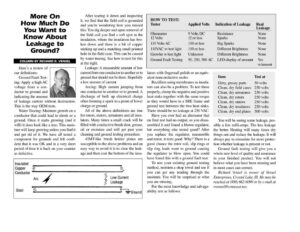
More On How Much Do You Want to Know About Leakage to Ground? COLUMN BY RICHARD R. VENSEL Here’s a review of our definitions: Ground Fault Test- ing: Apply a high AC voltage from a con- ductor to ground and |\) indicating the amount | se of leakage current without destruction. This is the way OEM tests. Water Treeing: Moisture growth on a conductor that could lead to shorts or a ground. Once it starts growing (and it will) it does look like a tree. This mois- ture will keep growing unless you find it and get rid of it. We have all tested a component for grounds and felt confi- dent that it was OK and in a very short period of time it is back on your counter as defective. After tearing it down and inspecting it, we find that the field coil is grounded and you’re wondering how you missed this. You dig deeper and upon removal of the field coil you find a soft spot in the insulation, where the insulation has bro- ken down and there is a bit of copper sticking up and a matching small pointed hole in the field case. This can be caused by water treeing. See how to test for this at the right. Leakage: A measurable amount of low current from one conductor to another or to ground that should not be there. Hopefully a low amount of current. Arcing: High current jumping from one conductor to another or to ground. A discharge of built up electrical charge often forming a spark to a point of lower charge or ground. All of the above definitions are true for rotors, stators, armatures and all insu- lators. Many times a small crack will be filled with conductive brush dust, grease, oil or moisture and will get past your cleaning and ground testing procedure. 42MT-like brush holder plates are susceptible to the above problems and an easy way to avoid it is to clear the leak- age and then coat the bottom of the insu- Insulated Copper Conductor Arc 4 Steel SoS = 2 Z Low Current g Leakage HOW TO TEST: Tester Applied Volts Indication of Leakage Real Leakage Ohmmeter 9 Volts DC Resistance None 12 Volts 12 or less Sparks None 110 Volts AC 110 or less Big Sparks None 110VAC wi/test light 110 or less Different Brightness None Growler w/test light | Unknown Different Brightness None Ground Fault Testing 50,250,500 AC LEDdisplay of amount Yes w/amount lators with fingernail polish or an equiv- alent nonconductive sealer. Item Test at Rectifiers using membranes as insula- Dirty, greasy parts 50 volts tors can also be a problem. To test these Clean, dry field cases 250 volts properly, clamp the negative and positive Clean, dry armatures 250 volts heat sinks together with the same torque Clean, dry rotors 250 volts as they would have in a SRE frame and Clean, dry stators 250 volts ground test between the two heat sinks. Clean, dry insulators 250 volts There should be no leakage at 250 VAC. Clean, dry end plates 500 volts Have you ever had an alternator that on final test had no output, so you disas- sembled it and found a blown regulator, but everything else tested good? After you replace the regulator, reassemble and retest, it tests good. Why? There is a good chance the rotor coil, slip rings or slip ring leads went to ground causing the regulator to blow open. You could have found this with a ground fault test. To test your existing ground testing method, moisten a shop towel and see if you can get any reading through the moisture. You will be surprised at what you are missing. For the most knowledge and salvage- ability test as follows: You will be seeing some leakage, pos- sibly a few milli-amps. The less leakage the better. Heating will many times dry things out and reduce the leakage. It will always pay to reinsulate for more protec- tion whether leakage is present or not. Ground fault testing will give you a whole new level of quality and assurance in your finished product. You will not believe what you have been missing and in most cases can correct. Richard Vensel is owner of Vensel Enterprises, Crystal Lake, Ill. He may be reached at (800) 662-6099 or by e-mail at rvensel@comcast.net.