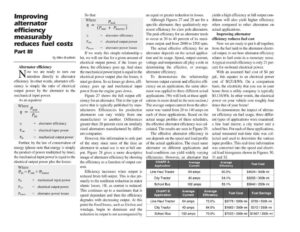
Improving alternator efficiency measurably reduces fuel costs Part Ill By Mike Bradfield Alternator efficiency N° we are ready to tum our attention directly to alternator efficiency. In other words, alternator effi- ciency is simply the ratio of electrical output power by the alternator to the mechanical input power. As an equation: Where Pout P, in n = alternator efficiency Pani = electrical input power Pin = mechanical output power Further, by the law of conservation of energy (please note that energy is simply the product of power multiplied by time), the mechanical input power is equal to the electrical output power plus the losses: Where as — sent + Piosses Pin = mechanical input power Pout electrical output power Phteases = alternator power losses So that: Where n= Pout (Pout + Piosses ) y = alternator efficiency Pout = electrical output power Prosses = alternator power losses If we study this simple relationship a bit, we will see that for a given amount of electrical output power, if the losses go down, the efficiency goes up. And since the mechanical power input is equal to the electrical power output plus the losses, it must go down. So as losses go down, effi- ciency goes up and mechanical input power from the engine goes down. Figure 27 shows the full output effi- ciency for an alternator. This is the type of curve that is typically published by man- ufacturers. Efficiencies for production alternators can vary widely from one manufacturer to another. Differences greater than 20 percent exist on similarly sized alternators manufactured by differ- ent companies. However, this information is only part of the story since most of the time an alternator in actual use is not at full out- put. Figure 28 gives a more descriptive image of alternator efficiency by showing the efficiency as a function of output cur- rent. Efficiency increases when output is reduced from full output. This is due pri- marily to the nonlinear reduction in stator ohmic losses, ?R, as current is reduced. This continues up to a maximum that is speed dependant and then the efficiency degrades with decreasing output. At this point the fixed losses, such as friction and windage, begin to dominate and the reduction in output is not accompanied by an equal or greater reduction in losses. Although Figures 27 and 28 are for a specific alternator, they qualitatively rep- resent efficiency for claw pole alternators. The peak efficiency for an alternator tends to occur at 30 to 40 percent of its maxi- mum output and from 2000 to 2500 rpm. The actual effective efficiency for an alternator depends on the actual applica- tion and its usage. Speed, output current, voltage and temperature all play a role in determining the effective, or average, alternator efficiency. To demonstrate the relationship between output current and effective effi- ciency on an application, the same alter- nator was applied to three different actual applications. (We will look at these appli- cations in more detail in the next section.) The average output current from the alter- nator was varied from 20 to 140 amps on each of these applications. Based on the actual usage profiles of these schedules, the effective alternator efficiency was cal- culated. The results are seen in Figure 29. The effective alternator efficiency in use depends on the speed and load profile of the actual application. The exact same alternator on different applications and load conditions can yield widely varying efficiencies. However, an alternator that CHART A Application Average Current yields a high efficiency at full output con- ditions will also yield higher efficiency when compared to other alternators on actual applications. Improving alternator efficiency reduces fuel cost Now we are ready to put it all together, from the fuel tank to the alternator electri- cal output, to see how alternator efficiency relates to fuel costs in a monetary sense. A typical overall efficiency is only 21 per- cent for on-board electrical power. With an assumed fuel cost of $4 per gal., this equates to an electrical power cost of $0.51/