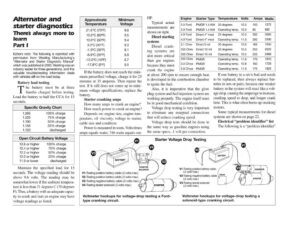
Alternator and starter diagnostics Theres always more to learn Part I Editor’s note: The following is reprinted with permission from Westling Manufacturing’s “Alternator and Starter Diagnostic Manual” which was published in 2003. Westling was an industry leader for three generations, and this valuable troubleshooting information deals with vehicles still on the road today. Battery lead testing he battery must be at three fourths charged before testing. Load the battery to half the CCA for 15 seconds. Specific Gravity Chart 1.265 100% charge 1.225 75% charge 1.190 50% charge 1.155 25% charge 1.120 discharged Open Circuit Battery Voltage 12.6 or higher 100% charge 12.4 or higher 75% charge 12.2 or higher 50% charge 12.0 or higher 25% charge 11.9 or lower discharged Maintain the specified load for 15 seconds. The voltage reading should be above 9.6 volts. The reading may be somewhat lower if the ambient tempera- ture is less than 21 degrees C (70 degrees F). Thus, a battery with an adequate capac- ity to crank and start an engine may have voltage readings as listed. HP. Approximate Minimum Temperature Voltage 21.0°C (70°F) 9.6 15.5°C (60°F) 9.5 10.0°C (50°F) 9.4 3.0°C (40°F) 9.3 -1.0°C (30°F) 9.1 -6.6°C (20°F) 8.9 -12.0°C (10°F) 8.7 -17.8°C (0°F) 8.5 If the battery does not reach the mini- mum prescribed voltage, charge it for 25 minutes at 35 amperes. Then repeat the test. If it still does not come up to mini- mum voltage specifications, replace the battery. Starter cranking amps How many amps to crank an engine? How much power to crank an engine? Depends on: engine size, engine tem- perature, oil viscosity, voltage to starter, cable size and condition. Power is measured in watts. Volts times amps equals watts; 746 watts equals one Vi-Testing positive battery cable (.2 volts max.) V2-Testing positive battery cable (.2 volts max.) V3-Testing negative battery cable (.2 volts max.) # * V4-Testing starter solenoid (.3 volts max.) Voltmeter hookups for voltage-drop testing a Ford- type cranking circuit. 7 é — ae ‘ Fl – y WA — 7 X STARTER SOLENOID Engine Starter Type Temperature Volts Amps Watts Typical actual 3.0 Ford PMGR1.4KW_ 30 degrees 10.5 150 1575 measurements are 3.0 Ford PMGR1.4KW Operating temp. 10.5 85 892 shown on right. 4.9 Ford Direct4” mod 25 degrees 10.2 300 3060 Diesel starting : systems 4.9 Ford Direct4” mod Operating temp. 11.0 200 2200 Diesel crank- 3.1 Chev Direct 5 mt 30 degrees 10.0 165 1650 ing systems are 350 Chev Direct 10 mt 30 degrees 10.5 250 2625 alot more critical 350 Chev Direct 10 mt Operating temp. 10.5 235 2468 than gas engines 350 Chev PMGR Operating temp. 11.0 170 1870 because they must 3.0 Chrys PMGR Operating temp. 10.8 160 1728 crank the engine 5.9 Chrys PMGR Operating temp. 11.0 175 1925 at about 200 rpm to ensure enough heat is developed in the combustion chamber to ignite the fuel. Also, it is imperative that the glow plug system and fuel injection system are working properly. The engine itself must be in good mechanical condition. Voltage drop testing is very important to eliminate any marginal connections that will reduce cranking speed. Voltage drop tests should be done in the same way as gasoline engines using the same specs, .1 volt per connection. Starter Voltage Drop Testing (2 volts max.) (.2 volts max.) V3-Testing starter solenoid (.3 volts max.) ; V1-Testing positive battery cable V2-Testing negative battery cable Voltmeter hookups for voltage-drop testing a solenoid-type cranking circuit. If one battery in a set is bad and needs to be replaced, then always replace bat- teries in sets or pairs, because one weaker battery in the system will react like a volt- age drop, causing the amperage to increase, cranking speed to drop, and longer crank time. This is what often burns up cranking motors. Some typical measurements for diesel systems are shown on page 22. Electrical “problem identifier” list The following is a “problem identifier”