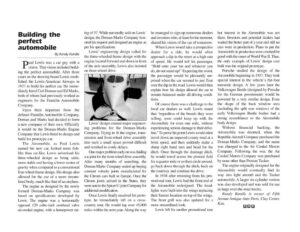
Building the perfect automobile By Randy Rundle Pp”! Lewis was a car guy with a vision. That vision included build- ing the perfect automobile. After three years on the drawing board Lewis estab- lished the Lewis-American Airways in 1937 to build his perfect car. He imme- diately hired Carl Doman and Ed Marks, both of whom had previously worked as engineers for the Franklin Automobile Company. Upon their departure from the defunct Franklin Automobile Company, Doman and Marks had decided to form a new company of their own. Officially it would be the Doman-Marks Engine Company that Lewis hired to design and build his prototype car. The Airomobile, as Paul Lewis named his new car, looked more fish- like than car-like. Lewis advertised his three-wheeled design as being safer, more stable and having a lower center of gravity when compared to a conventional four-wheel frame design. His design also allowed for the use of a more stream- lined body, much like that of an airplane. The engine as designed by the newly formed Doman-Marks Company was based on specifications developed by Lewis. The engine was a horizontally opposed 129 cubic-inch overhead valve air-cooled engine, with a horsepower rat- ing of 57. While not totally sold on Lewis’ design, the Doman-Marks Company hon- ored his request and designed an engine as per his specifications. Lewis’ engineering design called for the three-wheeled frame design with the engine located forward and down in front of the axle assembly. Lewis also insisted on front-wheel drive. Lewis’ design created major engineer- ing problems for the Doman-Marks Company. Trying to fit the engine, trans- mission and front-wheel drive assembly into such a small space proved difficult and resulted in costly delays. One major problem early on was finding au-joint for the front-wheel drive assembly. After many months of searching, the Doman-Marks Company ended up buying constant velocity joints manufactured for the Citroen cars built in Europe. Once the Citroen joints arrived in the States, they were sent to the Spicer U-joint Company for additional modification. Once Lewis finally received his proto- type, he immediately left on a cross- country tour. He would log over 45,000 miles within the next year. Along the way he managed to sign up numerous dealers and investors who, at least for the moment, shared his vision of the car of tomorrow. When Lewis would take a prospective dealer for a ride, he would often approach a dip in the street at a high rate of speed. He would tell his passenger, “Hold onto your hat and whatever you do, do not stand up!” Expecting the worst, the passenger would be pleasantly sur- prised when the car seemed to just float over the dip in the road. Lewis would then explain how his design allowed the car to remain balanced under all driving condi- tions. Of course there was a challenge to the local car dealers as well. Lewis stated that “regardless of the brands they were selling, none could keep up with the Airomobile for even one mile, without experiencing serious damage to their drive- line.’ To prove his point Lewis would often travel down an unpaved county road at a brisk speed, and then suddenly make a sharp right hand turn and head for the ditch. Once through the drainage ditch, he would travel across the plowed field for a quarter mile or so then circle around, go back down through the ditch, back on the roadway and continue his drive. In 1938 after returning from his pro- motional tour, Lewis had the front end of the Airomobile redesigned. The head- lights were built into the wings replacing their former location on top of the wings. The front grill was also updated for a more streamlined look. Lewis left for another promotional tour but interest in the Airomobile was not there. Investors and potential dealers had waited the better part of a year and still no cars were in production. Plans to put the Airomobile in production were crushed for good with the onset of World War II. Thus, the only example of Lewis’ design ever built was the original prototype. Porsche studied the design of the Airomobile beginning in 1937. They took special interest in the vehicle’s flat-four transaxle design. A few years later the Volkswagen Beetle (designed by Porsche for the German government) would be powered by a very similar design. Even the shape of the back window area (including the split rear window) of the early Volkswagen Beetle bodies had a strong resemblance to the Airomobile body design. Without financial backing, the Airomobile was doomed, when the Republic Aircraft Company purchased the Doman-Marks Company, and the name was changed to the Air Cooled Motors Company. Following the war, the Air Cooled Motors Company was purchased by none other than Preston Tucker. The engine originally designed for the Airomobile would eventually find its way into light aircraft and the Tucker automobile. A larger six-cylinder version was also developed and was sold for use in large ov