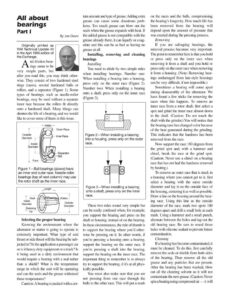
All about bearings Part I By Joe Davis Originally printed as WAI Technical Update 43 in the April 1999 edition of the Exchange. A nti-friction bear- ings seem to be very simple parts, but after you read this, you may think other- wise. They consist of two hardened steel rings (races), several hardened balls or rollers, and a separator (Figure 1). Some types of bearings, such as needle-roller bearings, may be used without a separate inner race because the rollers fit directly onto a hardened shaft. Many things can shorten the life of a bearing, and we would like to cover some of them in this issue. — Width + Outer Race Outside Diameter = Inner Race Inside Diameter ‘ Separator Ball Face Figure 1—Ball bearings (above) have an inner and outer race. Needle-roller bearings (top of next column) may use the rotor shaft as the inner race. Selecting the proper bearing Knowing the environment where the alternator or starter is going to operate is extremely important. What type of end thrust or side thrust will the bearing be sub- jected to? Is the application a passenger car or is it heavy-duty equipment or a truck? Is it being used in a dirty environment that would require a bearing with a seal rather than a shield? What is the temperature range in which the unit will be operating and can the seals and the grease withstand these temperatures? Caution: A bearing is packed with a cer- tain amount and type of grease. Adding extra grease can cause some disastrous prob- lems. Too much grease can blow out the seals when the grease expands with heat. If the added grease is not compatible with the grease already there, it can liquefy or coag- ulate and this can be as bad as having no grease at all. Installing, removing and cleaning bearings Installing You need to abide by two simple rules when installing bearings. Number one: When installing a bearing into a housing, press only on the outer race (Figure 2). Number two: When installing a bearing onto a shaft, press only on the inner race (Figure 3). Figure 2—When installing a bearing into a housing, press only on the outer race. Figure 3—When installing a bearing onto a shaft, press only on the inner race. These two rules sound very simple but can be easily confused when, for example, you support the bearing and press on the shaft or housing, instead of on the bearing. In these circumstances, the rule of thumb is to support the bearing where you’d other- wise be pressing on it. In other words, if you’re pressing a housing onto a bearing, support the bearing on the outer race. If you’re pressing a shaft into the bearing, support the bearing on the inner race. The important thing to remember is to always try to support the bearing, if it’s at all phys- ically possible. You must also make sure that you are not pressing from one race through the balls to the other race. This will put a mark on the races and the balls, compromising the bearing’s longevity. How much life has been removed from the bearing will depend upon the amount of pressure that was exerted during the pressing process. Removing If you are salvaging bearings, the removal process becomes very important. The point to remember here is that you hold or press only on the inner race when removing it from a shaft and you hold or press only on the outer race when removing it from a housing. (Note: Removing bear- ings undamaged from late-style housings can be very difficult, if not impossible.) Sometimes a bearing will come apart during disassembly of the alternator. We have found a few tricks for removing the races when this happens. To remove an inner race from a rotor shaft, first select a spot and grind the inner race almost down to the shaft. (Caution: Do not touch the shaft with the grinder.) You will notice that the bearing race has changed color because of the heat generated during the grinding. This indicates that the hardness has been removed from the race. Now support the race 180 degrees from the grind spot and, with a hammer and chisel, break the race at the grind spot. (Caution: Never use a chisel on a bearing race that has not had the hardness removed by heating.) To remove an outer race that is stuck in a housing where you cannot get to it, first select a bearing with the same outside diameter and lay it on the outside face of the housing, centering it as well as possible. Draw a line on the housing around the bear- ing race. Using this line as the outside diameter of the race, mark two spots 180 degrees apart and drill a small hole at each mark. Using a hammer and a small punch, alternate between the holes and tap out the old bearing race. Be sure to reseal those holes with silicone sealant to prevent future contamination. Cleaning If a bearing has become contaminated, it must be cleaned. To do this, first carefully remove the seals or shields from both sides of the bearing. Then remove all the old grease and any particles that are present. After the bearing has been washed, blow out all the cleaning sol