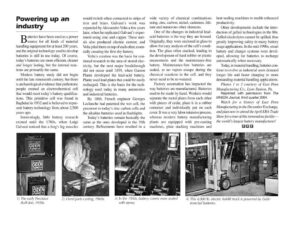
Powering up an industry B atteries have been used as a power source for all kinds of material handling equipment for at least 200 years, and the original technology used to develop batteries is still in use today. Of course, today’s batteries are more efficient, cleaner and longer lasting, but the internal reac- tions are primarily the same. Modern battery study did not begin until the late nineteenth century, but there is archaeological evidence that prehistoric people created an electrochemical cell that would meet today’s battery qualifica- tions. This primitive cell was found in Baghdad in 1932 and is believed to repre- sent battery technology from about 2,500 years ago. Interestingly, little battery research existed until the 1780s, when Luigi Galvani noticed that a frog’s leg muscles 1) The early Precision Built line, 1950s. 2) Hand parts casting, 1960s. would twitch when connected to strips of iron and brass. Galvani’s work was expanded by Alessandro Volta a few years later, when he replicated Galvani’s exper- iment using zinc and copper. These met- als also produced electric current, and Volta piled them on top of each other, essen- tially creating the first dry battery. Volta’s creation was the basis for con- tinued research in the area of stored elec- tricity, but the next major breakthrough did not occur until 1859, when Gaston Plante developed the lead-acid battery. Plante used lead plates that could be easily recharged. This is the basis for the tech- nology used today in many automotive and industrial batteries. By 1866, French engineer Georges Leclanche had patented the wet cell, the precursor to today’s zinc carbon cells and the alkaline batteries used in flashlights. Today’s batteries remain basically the same as the ones developed in the 19th century. Refinements have resulted in a 3) In the 1950s, battery covers were sealed with epoxy. wide variety of chemical combinations using, zinc, carbon, nickel, cadmium, lith- ium and numerous other elements. One of the changes in industrial lead- acid batteries is the way they are housed. Originally, they were enclosed in glass to allow for easy analysis of the cell’s condi- tion. The glass often cracked, leading to the development of hard rubber or plastic encasements and the maintenance-free battery. Maintenance-free batteries are sealed, so no vapors escape during the chemical reactions in the cell, and they never need to be re-watered. Factory automation has impacted the way batteries are manufactured. Batteries used to be made by hand. Workers would separate the metal plates from each other with pieces of cedar, place it in a rubber container and individually put on each cover. It was a very labor-intensive process, whereas modern battery manufacturing plants are equipped with pre-casting machines, plate stacking machines and heat-sealing machines to enable enhanced productivity. Other developments include the intro- duction of gelled technologies in the 80s. Gelled electrolytes cannot be spilled, thus greatly improving safety in many battery usage applications. In the mid-1990s, smart battery and charger systems were devel- oped, allowing for batteries to recharge automatically when necessary. Today, in material handling, batteries con- tinue to evolve as industrial users demand longer life and faster charging in more demanding material handling applications. Photos I to 3 courtesy of East Penn Manufacturing Co., Lyon Station, Pa. Reprinted with permission from The MHEDA Journal, third quarter 2004. Watch for a history of East Penn Manufacturing in the December Exchange, and plan now to attend the April ERA Trade Show for a tour of this tremendous facility — the world’s largest battery manufacturer! ETRIE| Pt eS . 4) This 4,000 Ib. electric forklift truck is powered by Exide- Ironclad batteries.