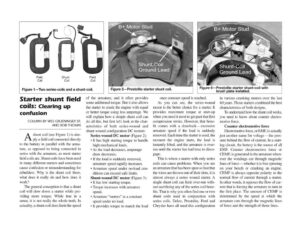
Field Coil Shunt Coil Figure 1—Two series-coils and a shunt-coil. Field Coil – B+ Motor Stud 2 Shunt-Coil : Ground Lead Figure 5— Prestolite starter shunt coil. Figure 6—Prestolite starter shunt-coil with brush plate installed. B+ Motor Stud = aa te Shunt-Coil Ground Lead Starter shunt field coils: Clearing up confusion COLUMN BY WES GRUENINGER SR. AND BOB THOMAS A shunt coil (see Figure 1) is sim- ply a field coil connected directly to the battery in parallel with the arma- ture, as opposed to being connected in series with the armature, as most starter field coils are. Shunt coils have been used in many different starters and sometimes cause confusion or misunderstanding for rebuilders. Why is the shunt coil there, what does it really do and how does it work? The general conception is that a shunt coil will slow down a starter while pro- viding more torque. While true in a sense, it is not really the whole truth. In actuality, a shunt coil does limit the speed of the armature, and it often provides some additional torque. But it also allows the starter to crank the engine with equal or better torque using less amperage. We will explain how a simple shunt coil can do all this, but first let’s look at the char- acteristics of both series-wound and shunt-wound configuration DC motors: Series-wound DC motor (Figure 2): ¢ It has high starting torque to handle high mechanical loads. ¢ As the load decreases, amperage draw decreases. ¢ If the load is suddenly removed, armature speed rapidly increases. e Armature speed under no-load con- ditions can exceed safe limits. Shunt-wound DC motor (Figure 3): ° It has low starting torque. ¢ Torque increases with armature speed. e Armature “motors” at a constant speed under no load. * It provides torque to match the load once constant speed is reached. As you can see, the series-wound motor is the better choice for a starter. It provides maximum torque at start-up when you need it most to get past that first compression stroke. However, that bene- fit comes with a drawback—excessive armature speed if the load is suddenly removed. Each time the starter is used, the moment the engine starts, the load is instantly lifted, and the armature is over- run until the starter has had time to disen- gage. This is where a starter with only series coils can cause problems. When you see an armature that has been spun so fast that the wires are thrown out of their slots, it is almost always a series wound starter. A single shunt coil can limit over-run with- out sacrificing any of the series coil bene- fits. That is why you often find one or two shunt coils used in conjunction with series coils. Delco, Prestolite, Ford and Chrysler have all used this configuration in various cranking motors over the last 60 years. Those starters combined the best characteristics of both designs. To understand how the shunt coil works, you need to know about counter electro- motive force. Counter electromotive force Electromotive force, or EME, is actually just another name for voltage—the pres- sure behind the flow of current. In a start- ing circuit, the battery is the source of all EMF. Counter electromotive force or CEME is generated in the armature when- ever the windings cut through magnetic lines of force—whether it is free spinning on your bench or cranking an engine. CEMF is always opposite polarity to the normal flow of current through a starter. In other words, it opposes the flow of cur- rent that is forcing the armature to turn in the first place. The amount of CEMF is determined by the speed at which the armature cuts through the magnetic lines of force and the strength of those lines.