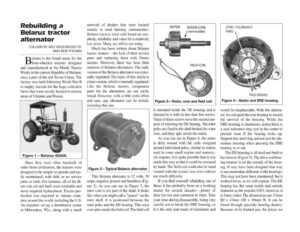
Rebuilding a Belarus tractor alternator COLUMN BY WES GRUENINGER SR. AND BOB THOMAS elarus is the brand name for the four-wheeled tractors designed and manufactured at the Minsk Tractor Works in the current Republic of Belarus, once a part of the old Soviet Union. The factory was built following World War II to supply tractors for the huge collective farms that were mostly located in remote areas of Ukraine and Russia. Figure 1 — Belarus 400AN. Since they were often hundreds of miles from civilization, the tractors were designed to be simple to operate and eas- ily maintained, with little or no service parts or tools. For instance, all of the fil- ters (air, oil and fuel) were washable and never required replacement. Excess pro- duction was exported to various coun- tries around the world, including the U.S. An importer set up a distribution center in Milwaukee, Wis., along with a small network of dealers that were located mainly in rural farming communities. Belarus tractors were sold based on sim- plicity, reliability and value for a relatively low price. Many are still in use today. Much has been written about Belarus tractor starters—the lack of their service parts and replacing them with Denso starters. However, there has been little mention of Belarus alternators. The early version of the Belarus alternator was exter- nally regulated. The topic of this article is a later version, which is internally regulated. Like the Belarus starters, component parts for the alternators are not easily found. However, with a little extra effort and care, any alternator can be rebuilt, including this one. Figure 2— Typical Belarus alternator. This Belarus alternator is 12 volts, 30 amps, negative ground and brushless (Fig- ure 2). As you can see in Figure 3, the rotor core is not part of the shaft. It looks like what you might call a “spacer” on the rotor shaft. It is positioned between the rotor poles and the DE bearing. This rotor core spins inside the field coil. The field coil ROTOR ROTOR CORE (removable) FIELD COIL Figure 3— Rotor, core and field coil. is mounted inside the DE housing and is fastened to it with no less than five screws. Three of these screws serve the second pur- pose of retaining the DE bearing. The rotor poles are fixed to the shaft behind the rotor core, and they spin inside the stator. As you can see in Figure 4, the stator is delta wound with the coils wrapped around individual poles, similar to stators used in some small marine and motorcy- cle engines. It is quite possible that it was made this way so that it could be rewound by hand. The field coil could also be hand wound with the correct size wire without too much difficulty. If you find yourself rebuilding one of these, it has probably been on a working tractor for several decades—plenty of time for rust and corrosion to form. Take your time during disassembly, being very careful not to break the SRE housing, as it is the only part made of aluminum and STEEL TOLERANCE TRIO DIGTHES. Figure 4— Stator and SRE housing. would be irreplaceable. With this alterna- tor, we cut apart the rear bearing to ensure the survival of the housing. While the SRE housing is aluminum, notice there is a steel tolerance ring cast in the center to prevent wear if the bearing locks up. Support this steel ring and not just the alu- minum housing when pressing the SRE bearing in or out. The DE housing is all steel and built to last forever (Figure 5). The drive-end bear- ing retainer is on the outside of the hous- ing. It may have been designed that way to accommodate different width bearings. This may not have been intentional, but it worked for us, as we will explain. The DE bearing has the same inside and outside diameter as the popular 6303, however, it is 5mm wider. The dimensions are 17mm ID x 47mm OD x 19mm W. It can be found through specialty bearing dealers. Because of its limited use, the prices we