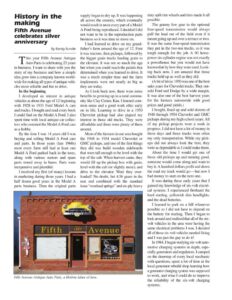
History in the making Fifth Avenue celebrates silver anniversary By Randy Rundle his year Fifth Avenue Antique Auto Parts is celebrating 25 years in business. I want to share with you the story of my business and how a simple idea grew into a company known world- wide for making all types of antique vehi- cles more reliable and fun to drive. In the beginning I developed an interest in antique vehicles at about the age of 12 beginning with 1928 to 1931 Ford Model A cars and trucks. I bought and read every book I could find on the Model A Ford. I also spent time with local antique car collec- tors who restored the Model A Ford cars as a hobby. By the time I was 14 years old I was buying and selling Model A Ford cars and parts. In those years (late 1960s) most every farm still had at least one Model A Ford parked back in the trees, along with various motors and spare parts stored away in barns. Parts were inexpensive and plentiful. I received my first (of many) lessons in marketing during those years. I had a half dozen good years in the Model A parts business. Then the original parts +–+ ee Fifth Avenue Antique Auto Parts, a lifetime labor of love. supply began to dry up. It was happening all across the country, which eventually would result in most every part of a Model A Ford being reproduced. I decided I did not want to be in the reproduction parts business so it was time to move on. I had learned to drive on my grand- father’s farm around the age of 12. First it was tractors, then pickups, followed by the bigger grain trucks hauling grain to the elevator. It was not so much the age but when you could reach the pedals that determined when you learned to drive. It was a much simpler time and the farm implements were not nearly as big as they are today. As I look back now, there were some benefits to growing up in a rural commu- nity like Clay Center, Kan. I learned com- mon sense and a good work ethic early on in life. Learning to drive in a 1950 Chevrolet pickup had also piqued my interest in those old trucks. They were affordable and there were plenty of them around. Most of the farmers in our area bought the 1948 to 1954 model Chevrolet or GMC pickups, and one of the first things they did was build wooden sideboards that were tall enough to be level with the top of the cab. When harvest came, they would fill up the pickup box with grain, level with the cab (or slightly more), and drive to the elevator. Were they over- loaded? No doubt, but 4.56 gears in the rear end combined with the standard issue “overload springs” and six-ply heavy a duty spilt rim wheels and tires made it all possible. The granny low gear in the optional four-speed transmission would always pull the load out of the field even if it meant going up and over a terrace or two. It was the same four-speed transmission they put in the two-ton trucks, so it was tough enough for the job. A 90 horse- power six-cylinder engine was not exactly a powerhouse but you would not have known that by how they were used. Look- ing back now, I am amazed that those trucks held up as well as they did. (A bit of trivia: 1950 was one of the best sales years for Chevrolet trucks. They out- sold Ford and Dodge by a wide margin. It was also one of the best harvest years for the farmers nationwide with good prices and good yields.) I bought, fixed up and sold dozens of 1948 through 1954 Chevrolet and GMC pickups during my high school years. All of my pickup projects were a work in progress. I did not have a lot of money in those days and those trucks were often my only transportation. While my pick- ups did not always look the best, they were as dependable as I could make them. About the time I would get one of those old pickups up and running good, someone would come along and want to buy it. A hundred dollars profit and down the road my truck would go—but now I had money to start on the next one. It was during these early years that I gained my knowledge of six-volt electri- cal systems. I experienced firsthand the hard starting, yellowish dim headlights, and the dead batteries. I learned to park on a hill whenever possible so I did not have to depend on the battery for starting. Then I began to look around and realized that all of the six- volt vehicles in the area were having the same electrical problems I was. I decided all of those six-volt vehicles needed fixing and I was just the guy to do it! In 1984, I began studying six-volt auto- motive charging systems in depth, espe- cially generators and regulators. I camped on the doorstep of every local mechanic with questions, spent a lot of time at the local generator rebuild shop learning how a generator charging system was supposed to work, and what I could do to improve the reliability of the six-volt charging systems.