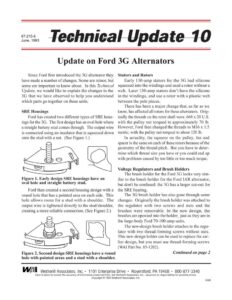
87-215-6 June, 1993 Update on Ford Since Ford first introduced the 3G alternator they have made a number of changes. Some are minor, but some are important to know about. In this Technical Update, we would like to explain the changes in the 3G that we have observed to help you understand which parts go together on these units. SRE Housings Ford has created two different types of SRE hous- ings for the 3G. The first design has an oval hole where a straight battery stud comes through. The output wire is connected using an insulator that is squeezed down onto the stud with a nut. (See Figure 1.) Figure 1. Early design SRE housings have an oval hole and straight battery stud. Ford then created a second housing design with a round hole that has a pointed area on each side. This hole allows room for a stud with a shoulder. The output wire is tightened directly to the stud/shoulder, creating a more reliable connection. (See Figure 2.) Figure 2. Second design SRE housings have a round hole with pointed areas and a stud with a shoulder. 3G Alternators Stators and Rotors Early 130-amp stators for the 3G had silicone squeezed into the windings and used a rotor without a web. Later 130-amp stators don’t have the silicone in the windings, and use a rotor with a plastic web between the pole pieces. There has been a major change that, as far as we know, has affected all rotors for these alternators. Orig- inally the threads on the rotor shaft were .668 x 20 U.S. with the pulley nut torqued to approximately 70 Ib. However, Ford then changed the threads to M16 x 1.5 metric, with the pulley nut torqued to about 120 Ib. In actuality, the squeeze on the pulley, fan and spacer is the same on each of these rotors because of the geometry of the thread pitch. But you have to deter- mine which thread size you have or you could end up with problems caused by too little or too much torque. Voltage Regulators and Brush Holders The brush holder for the Ford 3G looks very sim- ilar to the brush holder for the Ford IAR alternator, but don’t be confused: the 3G has a larger cut-out for the SRE bearing. The 3G brush holder has also gone through some changes. Originally the brush holder was attached to the regulator with two screws and nuts and the brushes were removable. In the new design, the brushes are epoxied into the holder, just as they are in the large-body Ford 70-100-amp units. The new-design brush holder attaches to the regu- lator with two thread-forming screws without nuts. This new-design holder can be used to replace the ear- lier design, but you must use thread-forming screws (WAI Part No. 85-1202). Continued on page 2 Wil Wetherill Associates, Inc. + 1101 Enterprise Drive – Royersford, PA 19468 + 800-877-3340 Care is taken to ensure the accuracy of information presented here, but Wetherill Associates, Inc., assumes no responsibility for possible errors. Copyright © 1993 Wetherill Associates, Inc. 3328 Intermediate Housing The OE intermediate housing for the Ford 3G has plasma compound sprayed onto it as an insulator between the housing and the positive heat sink. Aftermarket housings, on the other hand, use a thin insulation material for this same purpose. When you are repairing the rectifier on these units, heat transfer compound should be used. On aftermarket units, the compound should be used on both sides of the gasket. In addition, later OE housings are sprayed with a black insulating epoxy on the outer rim. (See Figure 3.) As a result, they don’t require an insu- lating sleeve on the stator leads. However, on housings that don’t have the epoxy, you must use an insulating sleeve on the stator leads. Figure 3. Later OE intermediate housings are sprayed with a black insulating epoxy and don’t require an insulating sleeve on the stator leads. Diodes Ford 3G alternators use Bosch-style diodes. The 95-amp units use 35-amp diodes, while the 130-amp units use 50-amp diodes. The problem here is that both of these diodes have the same base diameter of 13mm. As a result, you must test your diodes to make sure you have the cor- rect amperage. The higher amp diodes will have a slightly lower forward voltage drop. 3G Alternators for Limos and Police Cars The Ford 3G 130-amp units for limos and police cars use a new wiring harness-to-regulator plug with a wire retaining clip. This clip must be removed before you remove the harness from the regulator. To reinstall, simply replace the clip. The plug should then push on easily. Also note that this style of plug requires a different test harness and SRE housing than the other designs of this alternator. The SRE housing has a larger opening to accommodate this new plug. For complete parts information on Ford 3G alternators, watch for WAI’s new Ford 3G Series catalog, to be published soon. WAI Part No. 87-209-93