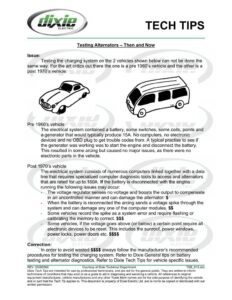
chiwie . & | [| { 8 | LD f TECH TIPS Testing Alternators — Then and Now Issue: Testing the charging system on the 2 vehicles shown below can not be done the same way. For the art critics out there the one is a pre 1960’s vehicle and the other is a post 1970’s vehicle. Pre 1960’s vehicle The electrical system contained a battery, some switches, some coils, points and a generator that would typically produce 15A. No computers, no electronic devices and no OBD plug to get trouble codes from. A typical practise to see if the generator was working was to start the engine and disconnect the battery. This resulted in some arcing but caused no major issues, as there were no electronic parts in the vehicle. Post 1970’s vehicle The electrical system consists of numerous computers linked together with a data line that requires specialized computer diagnostic tools to access and alternators that are rated for up to 160A. If the battery is disconnected with the engine running the following issues may occur: – The voltage regulator senses no voltage and boosts the output to compensate in an uncontrolled manner and can damage the alternator. $ – When the battery is reconnected the arcing sends a voltage spike through the system and can damage any one of the computer modules. $$ – Some vehicles record the spike as a system error and require flashing or calibrating the memory to correct. $$$ – Some vehicles, if the voltage goes above (or below) a certain point require all electronic devices to be reset. This includes the sunroof, power windows, power locks, power doors etc. $$$$ Correction: In order to avoid wasted $$$$ always follow the manufacturer’s recommended procedures for testing the charging system. Refer to Dixie General tips on battery testing and alternator diagnostics. Refer to Dixie Tech Tips for vehicle specific issues. REV: 20090902 Courtesy of Dixie Technical Department TSB_013.doc Dixie Tech Tips are intended for use by professional technicians, and are not for the general public. They are written to inform technicians of conditions that may exist or as a guide to aid in diagnosing and servicing a vehicle. All references to original equipment manufactures, vehicle manufactures and any other Trade Mark names are for the sole purpose of identifying the vehicle and or part that the Tech Tip applies to. This document is property of Dixie Electric Ltd. and is not to be copied or distributed with out written permission.