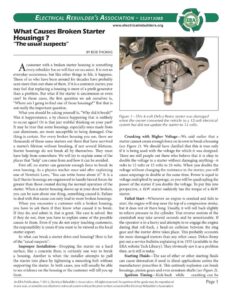
ELECTRICAL REBUILDER’S ASSOCIATION – S5201308B www.electricalrebuilders.org What Causes Broken Starter Housings ? “The usual suspects” BY BOB THOMAS Aw: with a broken starter housing is something every rebuilder has or will face on occasion. It is not an everyday occurrence, but like other things in life, it happens. Those of us who have been around for decades have probably seen more than our share of them. If it isa common starter, you may feel that replacing a housing is more of a profit generator than a problem. But what if the starter is uncommon or even rare? In those cases, the first question we ask ourselves is, “Where am I going to find one of those housings?” But that is not really the important question. What you should be asking yourself is, “Why did it break?” Was it happenstance, a by chance happening that is unlikely to occur again? Or is that just wishful thinking on your part? It may be true that some housings, especially ones made from cast aluminum, are more susceptible to being damaged. One thing is certain. For every broken housing you see, there are thousands of those same starters out there that have survived a starter’s lifetime without breaking, if not several lifetimes. Starter housings do not break all by themselves. They must have help from somewhere. We will try to explain some of the places that “help” can come from and how it can be avoided. First off, no starter can generate enough force to break its own housing. As a physics teacher once said after explaining one of Newton’s Laws, “You can write home about it!” It is a fact! Starter housings are engineered to handle lateral forces far greater than those created during the normal operation of the starter. When a starter housing shows up at your door broken, you can be sure about one thing, something caused it. Failure to deal with that cause can only lead to more broken housings. When you encounter a customer with a broken housing, you have to ask them if they know what caused it to break. If they do, and admit it, that is great. The case is solved. But if they do not, then you have to explain some of the possible causes to them. Even if you do not enjoy teaching customers, the responsibility is yours if you want to be viewed as the local starter expert. So what can break a starter drive-end housing? Here is list of the “usual suspects”: Improper Installation—Dropping the starter on a hard surface, like a concrete floor, is certainly one way to break a housing. Another is when the installer attempts to pull the starter into place by tightening a mounting bolt without supporting the starter. In both cases, you will usually be able to see evidence on the housing or the customer will tell you up front. An ERA Publication. © 2013, Electrical Rebuilder’s Association. All rights reserved. No portion of the guide may be reproduced Figure 1—This 6-volt Delco-Remy starter was damaged when the owner converted the vehicle to a 12-volt electrical system but did not update the starter to 12 volts. Cranking with Higher Voltage—We said earlier that a starter cannot create enough force on its own to break a housing (see Figure 1). We should have clarified that this is true only if it is being used with the voltage for which it was designed. There are still people out there who believe that it is okay to double the voltage to a starter without damaging anything—6 volts to 12 volts or 12 volts to 24 volts. When you double the voltage without changing the resistance in the starter, you will cause amperage to double at the same time. Power is equal to voltage multiplied by amperage, so you will be quadrupling the power of the starter if you double the voltage. To put this into perspective, a 1kW starter suddenly has the torque of a 4kW starter. Failed Start—Whenever an engine is cranked and fails to start, the engine will stop near the top of a compression stroke, but it does not sit there long. Usually, it will roll back slightly to relieve pressure in the cylinder. That reverse motion of the crankshaft may take several seconds and be unnoticeable. If the operator is in a hurry and attempts to re-engage the engine during that roll-back, a head-on collision between the ring gear and the starter drive takes place. This probably accounts for more damaged starters than any other cause. Delco-Remy put out a service bulletin explaining it in 1955 (available in the ERA website Tech Library). They obviously saw it as a problem then, as it still is today. Starting Fluids—The use of ether or other starting fluids can cause detonation if used in diesel applications unless the manufacturer prescribes it. This untimely explosion can break housings, pinion gears and even armature shafts (see Figure 2). Ignition Timing—Kick-back while cranking can be Page | in any way, or stored in any electronic retrieval system without the prior written consent of the Electrical Rebuilder’s Association.