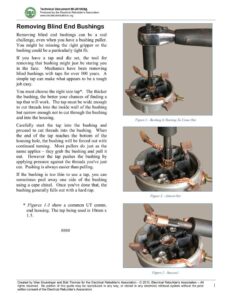
Technical Document MI-201008A Produced by the Electrical Rebuilder’s Association www.electricalrebuilders.org Removing Blind End Bushings Removing blind end bushings can be a real challenge, even when you have a bushing puller. You might be missing the right gripper or the bushing could be a particularly tight fit. If you have a tap and die set, the tool for removing that bushing might just be staring you in the face. Mechanics have been removing blind bushings with taps for over 100 years. A simple tap can make what appears to be a tough job easy. You must choose the right size tap*. The thicker the bushing, the better your chances of finding a tap that will work. The tap must be wide enough to cut threads into the inside wall of the bushing but narrow enough not to cut through the bushing and into the housing. Carefully start the tap into the bushing and proceed to cut threads into the bushing. When the end of the tap reaches the bottom of the housing hole, the bushing will be forced out with continued turning. Most pullers do just as the name applies — they grab the bushing and pull it out. However the tap pushes the bushing by applying pressure against the threads you’ve just cut. Pushing is always easier than pulling. If the bushing is too thin to use a tap, you can sometimes peel away one side of the bushing using a cape chisel. Once you’ve done that, the bushing generally falls out with a hard rap. * Figures 1-3 show a common UT comm. end housing. The tap being used is 10mm x 1.5. HHH Figure 2—Success! Created by Wes Grueninger and Bob Thomas for the Electrical Rebuilder’s Association – © 2010, Electrical Rebuilders Association — All rights reserved. No portion of this guide may be reproduced in any way, or stored in any electronic retrieval system without the prior written consent of the Electrical Rebuilder’s Association